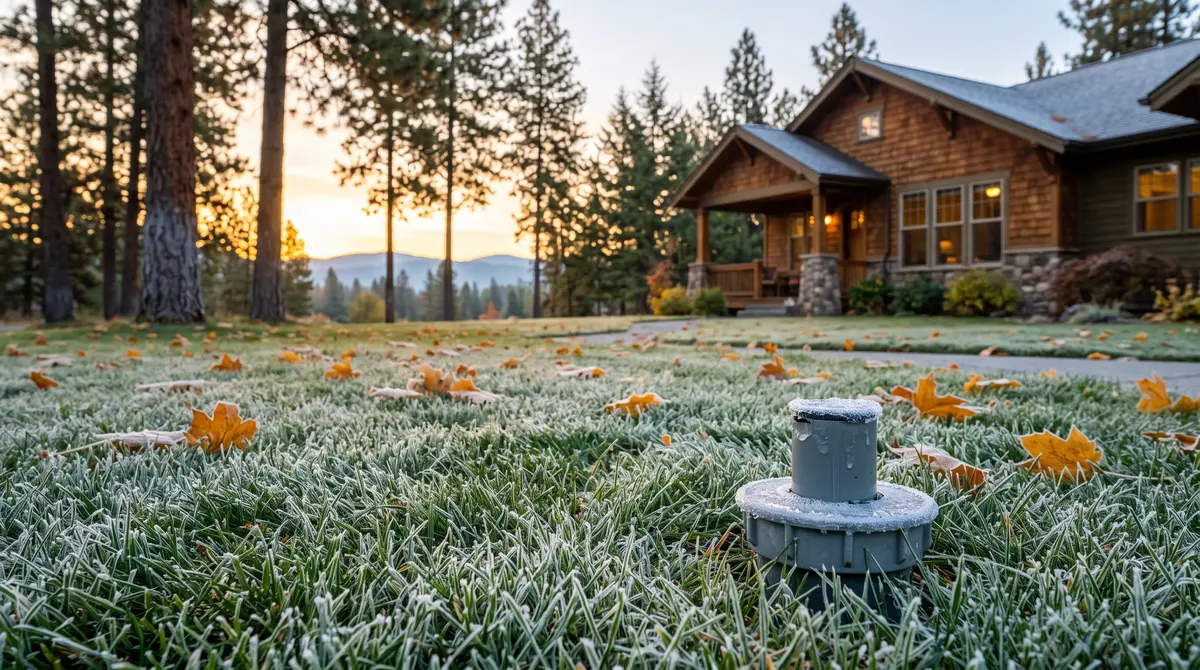
The first frosty morning in Spokane always does the same thing. Phones start ringing. Everyone who meant to schedule their sprinkler blowout in September looks out at a white lawn and realizes October is here. If that’s you, you’re not alone, and you’re probably not too late. But the window is closing.
This post covers when Spokane’s first freeze usually shows up, what actually happens to a sprinkler system that doesn’t get blown out in time, how to get on the schedule fast, and what to do if a hard freeze beats your appointment.
Quick Answer
Spokane’s first hard freeze typically arrives by mid-October, so the best time for a sprinkler blowout is October 1 to 15. A light frost usually won’t hurt your system, but several nights in the 20s with water still in the lines can crack backflow assemblies, valves, and pipe. If you haven’t booked yet, call now. If a hard freeze hits before your appointment, shut off the irrigation water, turn off the controller, and insulate the backflow device until a technician arrives.
When Is the First Freeze in Spokane?
Spokane sits in USDA hardiness zones 6a and 6b. That means cold winters with long stretches below freezing, and a fall that can turn quickly. Here’s the general pattern we plan around every year:
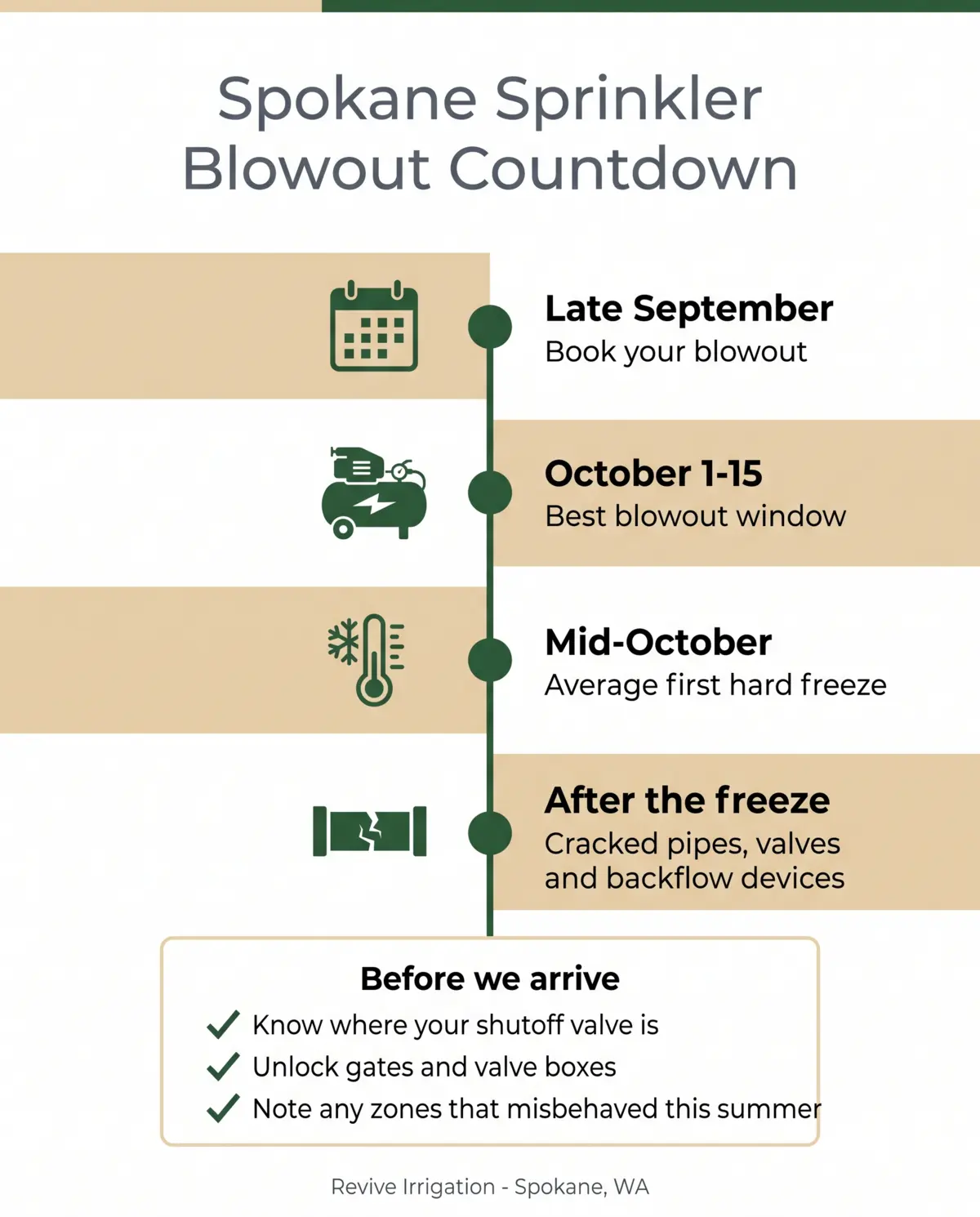
- Late September: Clear nights can bring the first light frost, especially in low spots, the West Plains, and north toward Mead and Deer Park.
- October 1 to 15: The sweet spot for a blowout. Days are still mild, nights are getting cold, and the lawn has done most of its growing for the year.
- Mid-October: The average first hard freeze. This is the temperature range that actually threatens your sprinkler system.
- Late October and beyond: Every week of waiting is a gamble. Some years stay mild into November. Some years we get a cold snap in the third week of October that sticks around.
There’s a difference between frost and a hard freeze. Frost forms on the grass when the air near the ground hits about 32°F. A hard freeze is a longer, deeper cold, generally in the upper 20s or below for several hours. Frost is a warning. A hard freeze is what turns water in a pipe into ice that expands and splits things.
The National Weather Service in Spokane posts frost advisories and freeze warnings for the Inland Northwest. When you see the words “freeze warning” in the forecast, that’s your last call.
What Happens If You Wait Too Long to Blow Out Your Sprinklers?
Water expands by roughly 9 percent when it freezes. Inside a closed pipe or valve, that expansion has nowhere to go, so it pushes outward until something gives. Here’s where we usually find the damage:
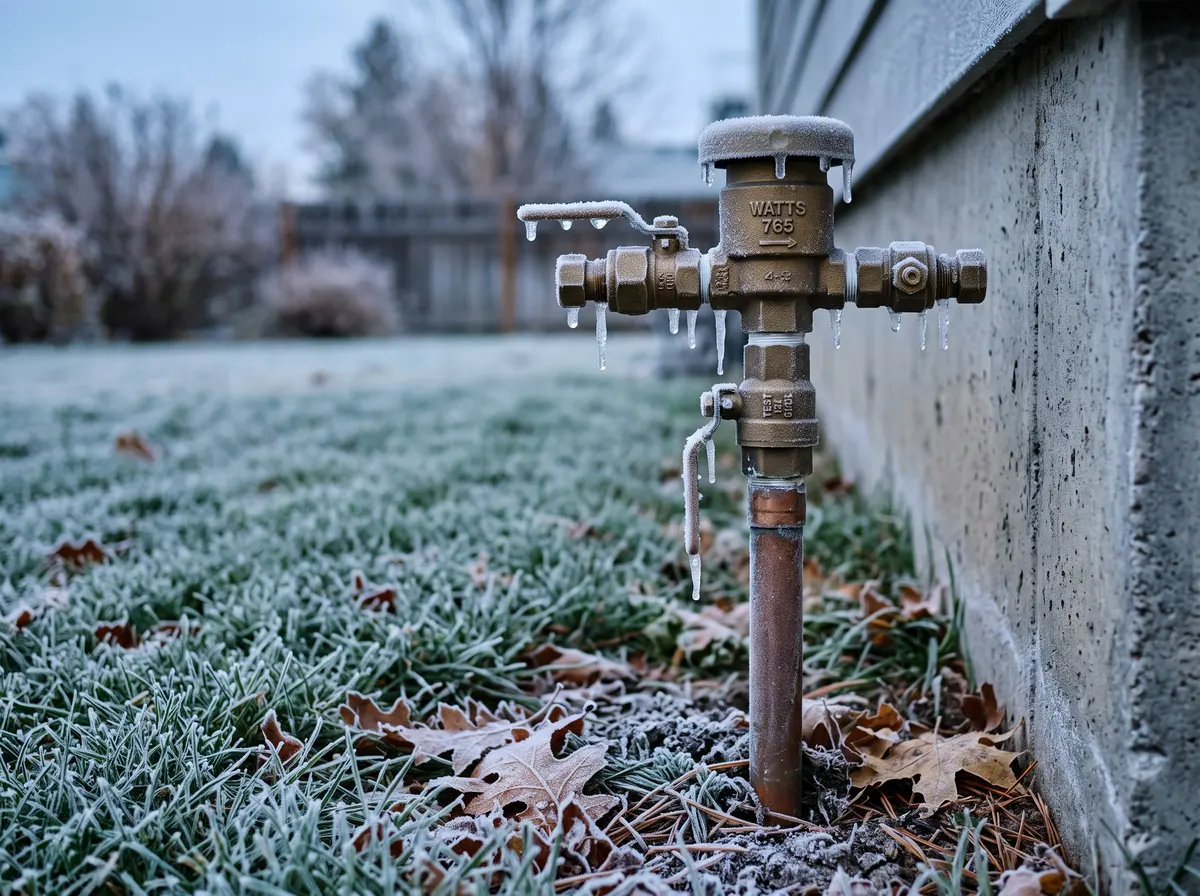
The backflow assembly
The backflow preventer is the brass device that keeps irrigation water from flowing back into your household drinking water. On most Spokane homes it’s mounted above ground near the foundation, which means it’s sitting in the open air. It freezes first and freezes hardest. A cracked backflow body or a split bonnet is one of the most expensive single parts on a residential system to replace. If you want the full story on that device, our post on backflow testing in Spokane explains what it does and what the state requires.
Valves and manifolds
Zone valves sit in a valve box a few inches below grade. They’re more protected than the backflow, but a long cold snap can still crack the plastic valve body or the solenoid housing.
Lateral lines and fittings
The pipe running out to your sprinkler heads is often only 8 to 12 inches deep. Spokane’s frost line runs deeper than that. Low spots where water collects are the usual failure points.
Why you won’t see it until spring
Freeze damage rarely shows up in November. The cracked fitting just sits there all winter. Then in April, someone turns the water on and finds a geyser in the side yard, a soggy patch that won’t dry out, or a zone with no pressure. By that point it’s a repair call instead of a maintenance visit. We cover what that spring discovery looks like in our spring sprinkler startup guide.
How Do I Book a Sprinkler Blowout Near Me in Spokane?
The fastest way is to call us at (509) 986-4262, Monday through Friday, 8:00 AM to 5:00 PM. You can also send a request through our contact page and we’ll get back to you with a time.
We work across Spokane, Spokane Valley, Liberty Lake, Mead, Cheney, Deer Park, Airway Heights, North Spokane and Five Mile Prairie, Nine Mile Falls, and Elk. We route appointments by neighborhood, so it helps to have a few details ready when you call:
- Your address and approximate zone count. If you don’t know, count the stations on your controller.
- Where your irrigation shutoff is. Often in the basement, a crawlspace, or a box near the water meter.
- Gate and pet info. Most blowouts don’t need you home, but we do need to get to the backflow and controller.
- Anything that acted up this summer. A zone that wouldn’t shut off, a leaking head, a soggy spot. We can flag it now so it’s ready to fix in spring.
On the price side, most residential blowouts in Spokane run about $75 to $150 as of 2026, depending on zone count. Larger lots, drip zones, and commercial or HOA properties cost more. You’ll get a good estimate up front; zone count and drip lines set the final cost.
Want a deeper look at what a proper winterization includes and why the air pressure and volume matter? Our full guide to sprinkler winterization in Spokane walks through the whole process, step by step.
A Hard Freeze Is Coming and I’m Not on the Schedule. What Now?
It happens every year. The forecast drops into the low 20s three days before your appointment. Here’s how to protect the system until we get there:
- Shut off the irrigation water. Close the main irrigation shutoff valve. This stops more water from feeding into the system.
- Turn the controller off. Set it to “off” or “rain mode” so it doesn’t try to run a zone against a closed valve, or worse, run water into lines the night before a freeze.
- Insulate the backflow assembly. Use a store-bought insulated backflow cover, or wrap it with old towels and seal a plastic bag over the top to keep moisture out. Don’t use heat tape or a space heater outdoors.
- Keep your appointment. These steps buy you time. They don’t push the water out of the lines.
What you shouldn’t do: try a blowout with a small shop compressor. Too little air volume leaves water behind in the low spots. Too much pressure can blow apart fittings and heads. We see both every fall.
Spokane Sprinkler Blowout FAQ
When is the first freeze in Spokane? Light frost can show up as early as late September. The first hard freeze, the kind that cracks pipes, typically arrives by mid-October. Aim for a blowout between October 1 and 15.
Is it too late to book a sprinkler blowout in Spokane? Usually not, if you call now. One light frost rarely does damage. Sustained hard freezes with water still in the lines are the real risk.
How much does a sprinkler blowout cost in Spokane? As of 2026, most residential blowouts run about $75 to $150 depending on zone count. Bigger properties and drip zones cost more.
Do I need to be home for my sprinkler blowout? Usually not. We need access to the shutoff, the backflow assembly, and the controller, plus unlocked gates.
What should I do if a hard freeze is forecast before my blowout? Shut off the irrigation water, turn the controller off, and insulate the backflow assembly. Then keep your appointment.
Can a sprinkler system freeze before the blowout? Yes. The above-ground backflow assembly and shallow pipe are the most exposed, especially during a run of nights in the low 20s.
Get on the Schedule Before the Freeze Warning
Brad and Joe have spent more than 20 years each blowing out Spokane sprinkler systems, and the pattern never changes: the people who call in the first week of October get their pick of times, and the people who wait for the freeze warning get a waitlist. A blowout costs a fraction of a spring repair. Call (509) 986-4262 or request your sprinkler blowout online, and see our full list of irrigation and sprinkler services for everything else we handle, from repairs to new installs with free estimates. For more on fall lawn care in our region, WSU Extension in Spokane County is a great local resource.
Revive Irrigation Services, Spokane, WA. 2303 W Rosewood Ave, Spokane, WA 99208. (509) 986-4262. Serving Spokane, Spokane Valley, Liberty Lake, Mead, Cheney, Deer Park, Airway Heights, Five Mile Prairie, Nine Mile Falls, and Elk.
Frequently asked questions
When is the first freeze in Spokane?
Light frost can show up in Spokane as early as late September. The first hard freeze, the kind that can crack sprinkler pipes and valves, typically arrives by mid-October. Plan to have your sprinkler blowout done between October 1 and October 15.
Is it too late to book a sprinkler blowout in Spokane?
Usually not, as long as you call now. Most of October is still workable. A single light frost rarely damages a system. What does the damage is a sustained hard freeze, or several nights in the 20s, with water still sitting in the pipes.
How much does a sprinkler blowout cost in Spokane?
As of 2026, most residential sprinkler blowouts in the Spokane area run about $75 to $150 depending on how many zones you have. Large lots, commercial properties, and systems with drip zones can cost more. Call for a quote.
Do I need to be home for my sprinkler blowout?
Usually not. If the technician can reach your irrigation shutoff, backflow assembly, and controller, and the gates are unlocked, the blowout can be done while you are at work. Let us know about dogs, locked gates, or a controller inside the garage when you book.
What should I do if a hard freeze is forecast before my blowout?
Shut off the water to your irrigation system at the main irrigation valve, turn the controller off, and wrap the above-ground backflow assembly with an insulated cover or old towels and a plastic bag. That buys time until your appointment. It does not replace a blowout.
Can a sprinkler system freeze before the blowout?
Yes. The above-ground backflow assembly and any shallow pipe are the most exposed. One frosty night is rarely a problem, but a run of nights in the low 20s can split brass, PVC fittings, and valve bodies that are still full of water.