If you own a sprinkler system in Spokane and your water comes from the city or a water district, a letter shows up every year asking for a backflow test. A lot of homeowners toss it in the pile and wonder if it actually matters. It does. Backflow testing in Spokane is not a suggestion from the utility. It is a Washington State requirement, and skipping it can end with your water shut off.
This post explains what a backflow assembly is, what the state actually requires, what a test involves, what it costs in the Spokane area, and what to do if your device fails.
Quick Answer
Washington State requires every irrigation system connected to a public water supply to have a backflow prevention assembly, and that assembly must be tested at least once every 12 months by a state-certified Backflow Assembly Tester. In Spokane, a residential test typically costs $60 to $120 per device as of 2026 and takes 15 to 30 minutes. If you ignore the notice, the water purveyor can fine you or shut off service until the test is done.
What Is a Backflow Preventer and Why Does a Sprinkler System Need One?
Your sprinkler system is a cross-connection. That is the plumbing term for any point where the clean drinking water supply touches a system that could carry something you would not want to drink. Sprinkler lines sit in soil that holds fertilizer, pet waste, lawn chemicals, and standing water. Drip lines can sit in mulch and garden beds.
Under normal conditions water only flows one direction, from the street into your yard. But pressure in the city main can drop. A water main break, a hydrant opened by the fire department, or a big pump running nearby can all cause it. When that happens, water can get pulled backward from your irrigation pipes into the house plumbing, and in a bad case, into the public main. That reverse flow is called backflow.
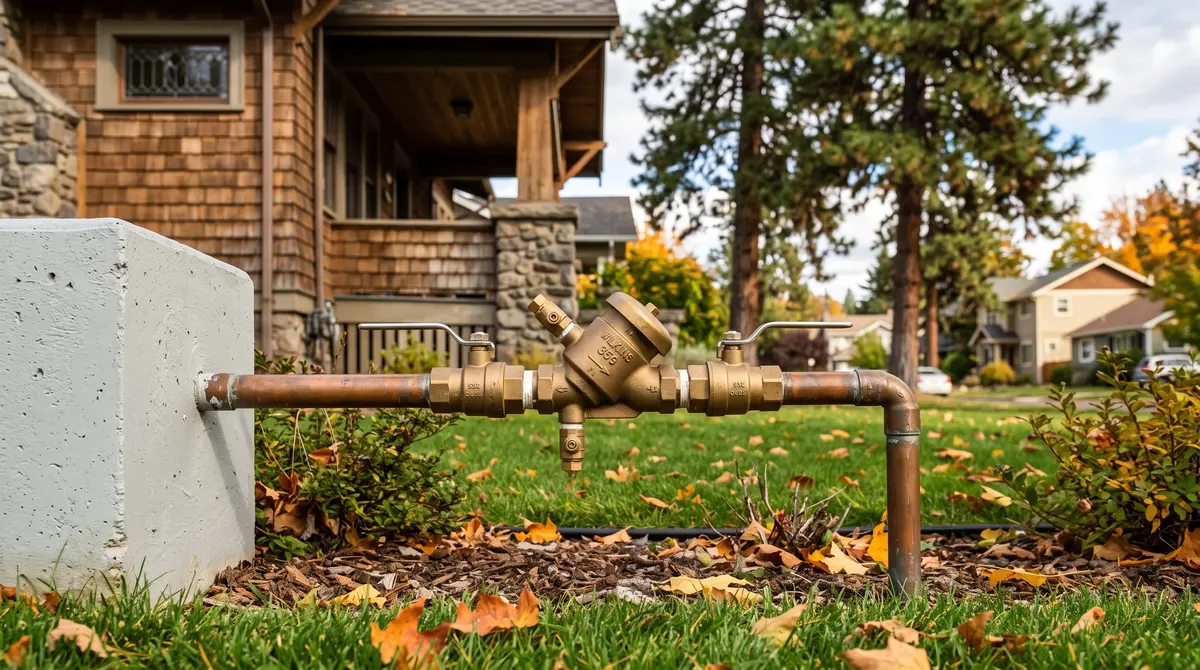
A backflow prevention assembly is a mechanical device on the irrigation supply line that stops that reverse flow. Most Spokane homes have one of three types:
- Pressure vacuum breaker (PVB). The most common on residential sprinklers. Mounted above ground, at least 12 inches higher than the highest sprinkler head. Uses a spring-loaded check valve and an air inlet valve.
- Double check valve assembly (DCVA). Two independent check valves in a row. Can be installed in a below-grade box, which is why you see them in newer Spokane subdivisions.
- Reduced pressure backflow assembly (RPBA). The highest level of protection. Required when a system injects fertilizer or where the local purveyor calls for it. Common on commercial and HOA properties.
If you are not sure which one you have, look for a brass or bronze assembly with two small test cock ports on it, usually near the house where the irrigation line splits off from the main. That is the device the state wants tested.
Do I Need Backflow Testing in Washington?
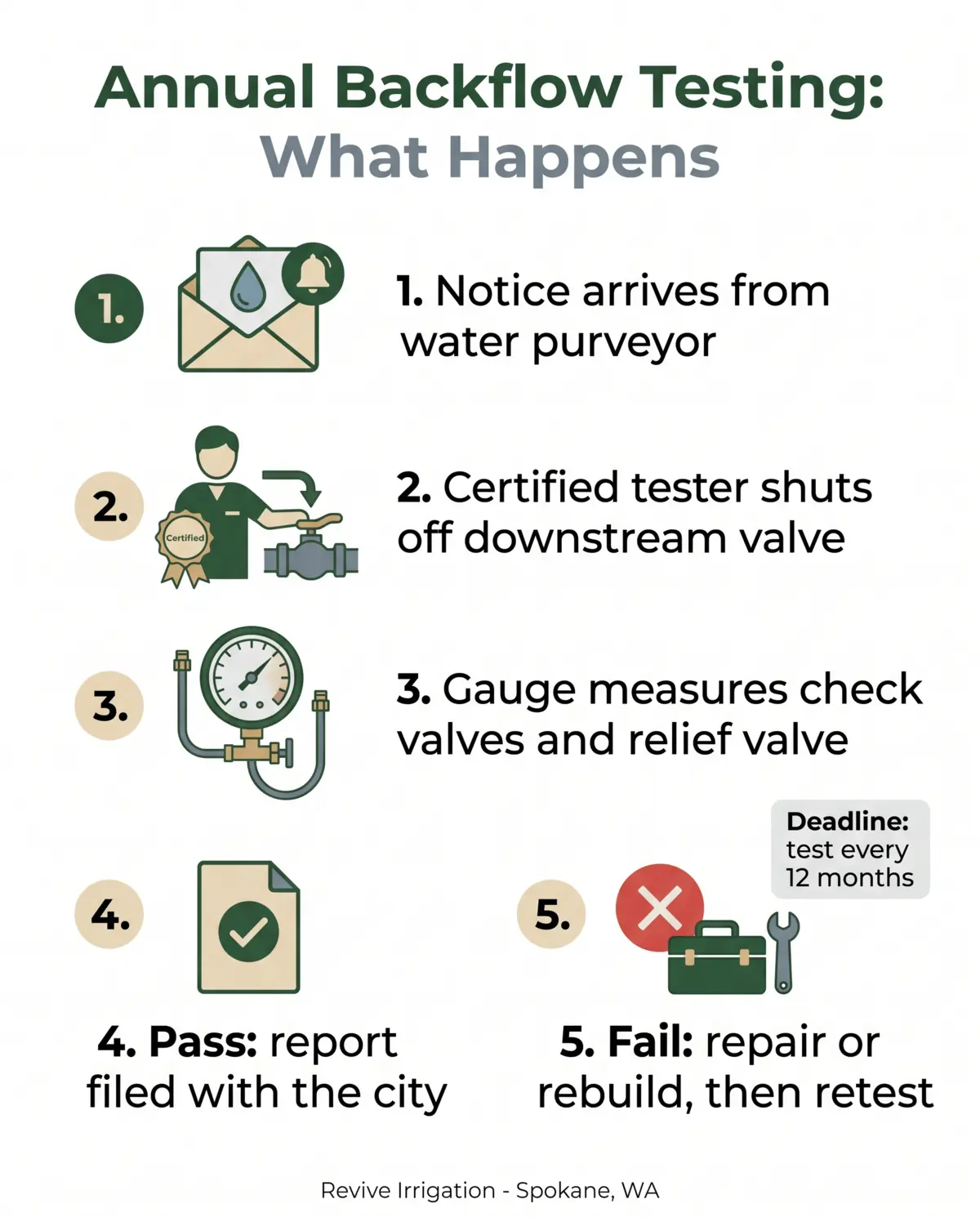
Yes, if your irrigation system is connected to a public water supply. The rule lives in Washington Administrative Code 246-290-490, the state’s cross-connection control regulation. It requires every water purveyor to run a cross-connection control program, and it requires backflow assemblies to be tested when installed, after any repair or relocation, and at least once a year after that. You can read the full text on the Washington State Legislature site.
The state does not send the tester. The water purveyor does the enforcing. In the Spokane area that could be the City of Spokane Water Department, Spokane County Water District No. 3, Whitworth Water District, Vera Water and Power, Modern Electric Water Company, Liberty Lake Sewer and Water District, or one of a dozen smaller systems. Each one keeps a list of every backflow assembly in its service area and mails test notices on its own schedule.
A few things the notice will say, in one form or another:
- The test must be done by a Washington State certified Backflow Assembly Tester (BAT).
- The test has to be completed by a specific date, usually 30 to 60 days out.
- The tester submits the results on the purveyor’s form, sometimes through an online portal.
- If the assembly fails, it must be repaired and retested.
The City of Spokane publishes its own cross-connection control requirements on the City of Spokane Water Department page. If you are on a district instead of the city, check the district’s website or the number on your notice.
One point homeowners ask about a lot: if you are on a private well and your sprinkler system is fed from that well only, the state cross-connection rule does not apply to you the same way, since there is no public supply to protect. Many well owners still install a backflow device to protect their own household water, and we recommend it, but it is not enforced by a purveyor.
What Gets Tested During a Backflow Test?
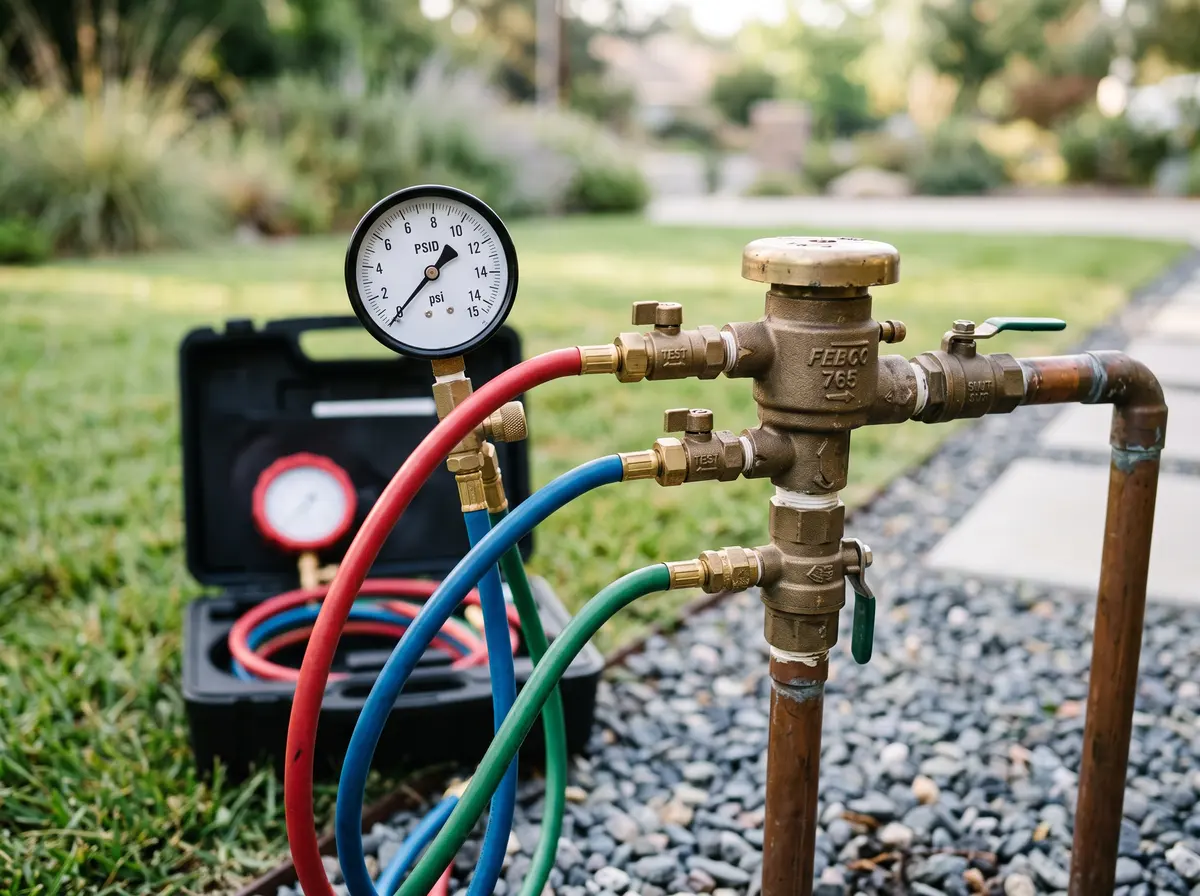
A backflow test is a pressure test on the individual parts inside the assembly. The tester hooks a calibrated differential pressure gauge to the test cocks, shuts off the downstream valve, and checks each component against a minimum value set by the manufacturer and the state.
For the three common assembly types, here is what gets measured:
Pressure vacuum breaker
The tester checks that the air inlet valve opens at or above 1.0 psi and that the check valve holds at or above 1.0 psi. If the air inlet does not open, the device cannot break a siphon and it fails.
Double check valve assembly
Both check valves are tested independently. Each one has to hold at least 1.0 psi in the direction of flow. A check valve that leaks even slightly, often from a bit of grit or a worn rubber disc, fails the test.
Reduced pressure backflow assembly
The first check valve has to hold at least 5.0 psi, the second check has to hold, and the relief valve has to open at no less than 2.0 psi. This is the most involved test and the one most likely to catch a marginal device.
The whole thing takes 15 to 30 minutes on a residential system. Your irrigation water is off during the test. Household water is not affected because the assembly sits on the irrigation branch, not the main line into the house.
The tester also checks the basics: shutoff valves that actually close, test cocks that are not stripped or seized, an assembly that is installed at the right height and orientation, and a device that matches what the purveyor has on file. If an assembly was replaced at some point and the purveyor was never told, that mismatch has to be sorted out too.
How Much Does Backflow Testing Cost in Spokane?
As of 2026, a residential backflow test in the Spokane area typically runs between $60 and $120 per assembly. Homes with more than one assembly, which happens when a system was expanded, pay per device. Commercial and HOA properties with RPBAs usually fall in the $90 to $175 range per assembly because the test takes longer and the devices are bigger.
That price covers the test and the paperwork. It does not cover repairs.
If the assembly fails, the fix is usually one of these:
- Rebuild kit. New check valve discs, springs, and seals for the existing body. Typically $150 to $300 installed, depending on the make and size.
- Full assembly replacement. Needed when the body is cracked, usually from freezing, or when parts are no longer made. Typically $250 to $600 for a residential PVB or DCVA, more for an RPBA.
- Retest after repair. Required by the state. Some testers include it in the repair price; some charge a reduced retest fee.
Prices shift with parts costs and device brand, so treat these as ranges. We are happy to give you a firm number over the phone once we know what you have.
Cracked bodies deserve a special mention for Spokane. A PVB sits above ground, full of water, all year. If it is not drained during sprinkler winterization, the first hard freeze in mid-October can split the brass. We see this every spring. A proper blowout drains the assembly and saves you a $400 replacement.
What Happens If You Skip Backflow Testing?
Nothing happens the first week. The problem builds.
Purveyors follow a fairly predictable escalation, and while the exact steps vary by utility, the pattern in the Spokane area looks like this:
- First notice. Usually mailed with a 30 to 60 day deadline. Many purveyors send it in spring right around startup.
- Reminder or second notice. Sent after the deadline passes. Some utilities add a late or administrative fee at this stage.
- Notice of noncompliance. A formal letter stating the property is out of compliance with WAC 246-290-490 and the purveyor’s own cross-connection ordinance.
- Water shutoff. The purveyor has the authority to discontinue service to a property with an untested or failed assembly. In practice this is rare on residential accounts, but it does happen, and getting turned back on means paying the test plus a reconnection fee.
Beyond the paperwork, there is the reason the rule exists. An untested assembly can sit failed for years with no visible sign. The one time the city main loses pressure, your irrigation water becomes the household water. The state has documented real cases of lawn chemicals and fertilizer pulled back into home plumbing through unprotected sprinkler connections, which is why the annual test is not optional.
There is a side benefit too. A failed check valve often shows up first as a system that will not hold pressure or a PVB that spits water out the top every time the system runs. Those are repair symptoms we fix through our sprinkler repair service, and catching them during the annual test is cheaper than finding them mid-July.
When Should You Schedule Backflow Testing in Spokane?
The deadline on your notice is the one that matters, but if you have flexibility, spring startup is the natural time. The system is being pressurized for the season anyway, and a test right after startup catches freeze damage before it wastes a summer of water.
For Spokane that means mid-April through mid-May for most systems. If you have a startup and a test scheduled together, one visit covers both.
Fall is the second-best window. Some purveyors, especially in Spokane Valley and Liberty Lake, send notices in late summer. A test in September or early October still leaves time for repairs before winterization.
What we do not recommend is waiting until the notice says “final.” Certified testers are stretched thin in the busy season across Spokane, Mead, Cheney, and the Valley, and a two-week wait for an appointment can push you past the deadline.
For homeowners who want it handled, we can test your assembly, file the report with your purveyor, and if it fails, repair or replace it on the same visit. Property managers and HOAs in the area with multiple assemblies can set up a single annual date so every device gets tested and reported together.
Book Your Spokane Backflow Test
If a backflow notice is sitting on your counter, or you are not sure whether your system has ever been tested, call Revive Irrigation at (509) 986-4262. We will check what is on file, test your assembly, and handle the paperwork with your water purveyor. Repairs and replacements come with a free estimate before any work starts.
Contact us online or call during business hours, Monday through Friday, 8:00 AM to 5:00 PM.
Revive Irrigation Services, 2303 W Rosewood Ave, Spokane, WA 99208. (509) 986-4262. Serving Spokane, Spokane Valley, Liberty Lake, Mead, Cheney, Deer Park, Airway Heights, North Spokane, Nine Mile Falls, and Elk.
Frequently asked questions
Do I need backflow testing in Washington State?
Yes, if your sprinkler system connects to a public water supply. Washington Administrative Code 246-290-490 requires backflow prevention assemblies to be tested at least once a year by a state-certified Backflow Assembly Tester, and the water purveyor has to enforce it.
How much does backflow testing cost in Spokane?
As of 2026, a residential backflow test in the Spokane area typically runs $60 to $120 per assembly. Repairs or a full rebuild of a failed assembly are billed separately, usually $150 to $400 depending on the device.
What happens if I skip my backflow test?
The water purveyor sends reminders, then a notice of noncompliance. Continued noncompliance can lead to fines or the utility shutting off water to the property until the test is done.
How long does a backflow test take?
Most residential tests take 15 to 30 minutes. Water to the irrigation system is shut off briefly during the test, but household water is not interrupted.
When is the best time to test backflow in Spokane?
Spring startup, between mid-April and mid-May, is the most convenient window because the assembly is being pressurized anyway. If your notice arrives at another time, test then. The deadline on the notice is what counts.
Can I test my own backflow preventer?
No. Washington requires the test to be done by a certified Backflow Assembly Tester using a calibrated gauge, and the results have to be submitted to the water purveyor on their form.