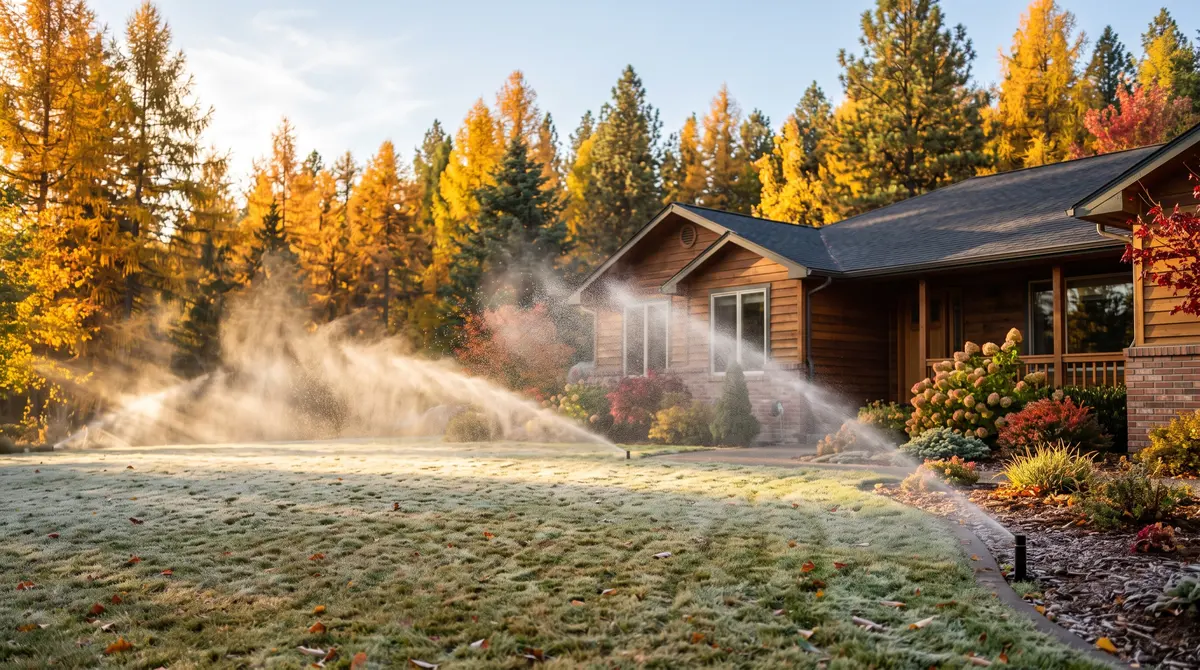
Every October, Spokane’s first hard freeze arrives on schedule, and every April we meet the systems that weren’t ready for it: cracked laterals, split manifolds, backflow assemblies ruined from the inside. Winterization is the cheapest service on the irrigation calendar, and skipping it is the most expensive mistake a Spokane homeowner can make with a sprinkler system. Here’s when to schedule, what a blowout actually involves, what it costs, and why the DIY version cracks more pipe than it saves.
Quick answer: Winterize your Spokane sprinklers between October 1 and October 15, the first hard freeze typically lands by mid-October. A professional blowout uses high-volume compressed air to clear water from every zone and runs $75 to $150 for most residential systems as of 2026. Skipping it risks cracked pipe, split fittings, and a ruined backflow assembly that you won’t discover until spring.
When should I winterize my sprinklers in Spokane?
The target window is October 1 to October 15.
Spokane sits in USDA zone 6, and our average first hard freeze arrives in mid-October, some years a touch later, some years it shows up in the first week. The National Weather Service in Spokane tracks freeze dates and frost advisories, and by the time a hard freeze warning is in the forecast, every irrigation company in the county is booked solid for two weeks. The homeowners who wait for the warning are the ones watering their lawns in November with a garden hose and a repair appointment.
Two practical rules:
- Book in late September. You’ll get a slot in the safe window instead of gambling on a warm October.
- A light frost isn’t the deadline, a hard freeze is. Grass can frost over while the ground stays warm. It’s the sustained sub-freezing nights that reach pipe at depth. But don’t cut it close; the schedule fills faster than the forecast changes.
Keep watering until your blowout, though, fall root growth matters, and your lawn shouldn’t go into winter bone dry.
What does a sprinkler blowout actually do?
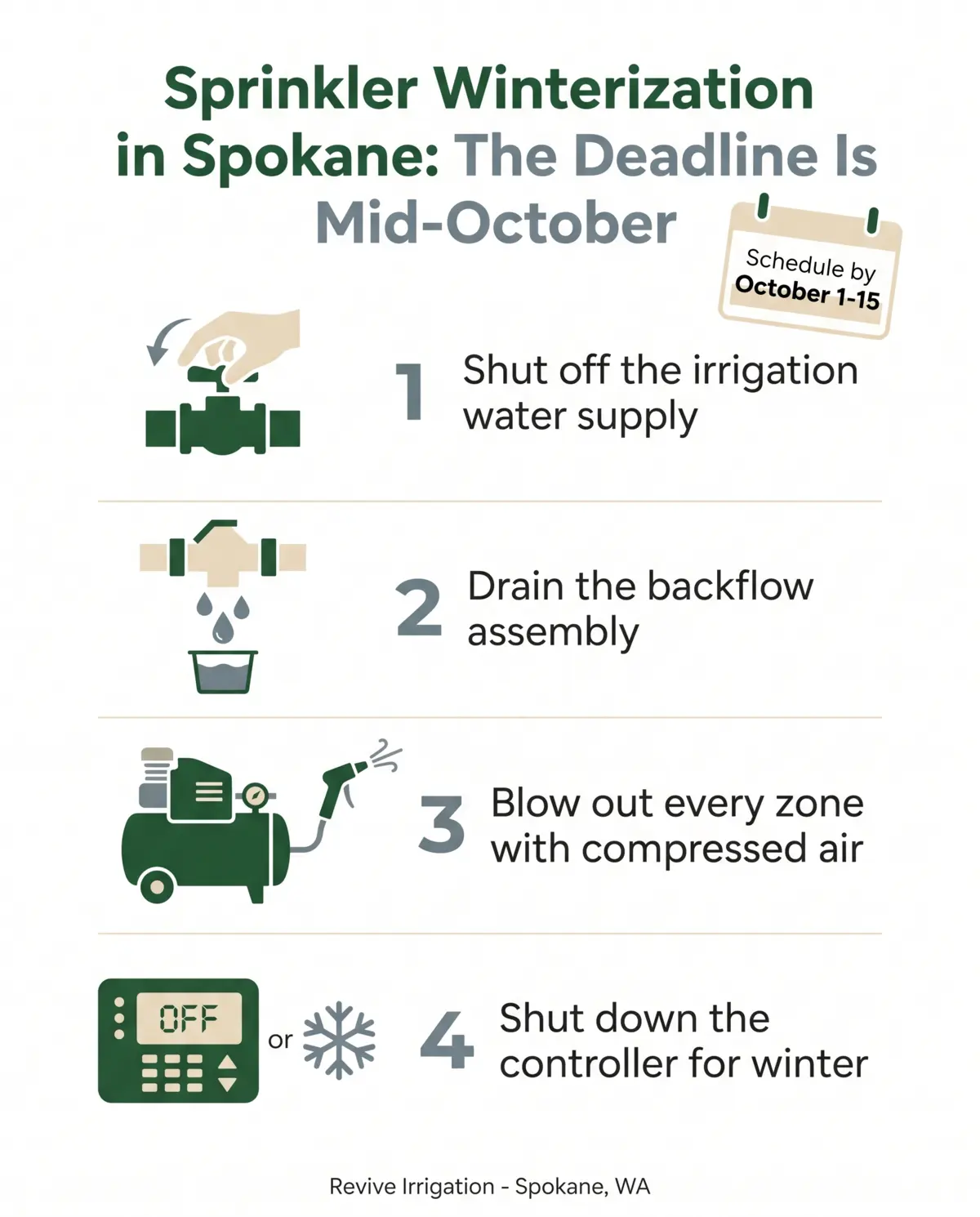
“Blowout” is the honest name for it: we push every drop of water out of the system with compressed air before that water can freeze. A proper winterization has four parts:
- Shut off the irrigation supply. The valve that feeds the system gets closed, isolating it from your house water.
- Drain and open the backflow assembly. The backflow preventer is the most freeze-vulnerable and most expensive single component on the system. Its valves get opened to the correct winter positions so trapped water can’t split the body.
- Blow out every zone with high-volume air. Zone by zone, regulated compressed air pushes water out through the heads until each zone runs dry mist. Every zone, every time, the one zone that gets skipped is always the one that cracks.
- Shut down the controller. Set to off or “rain mode” for the winter so a warm-week glitch doesn’t run water into empty lines. (If you’ve got a smart controller, it’ll sit out the winter happily, see our new guide to smart sprinkler controllers in Spokane.)
The whole visit takes 20 to 40 minutes for a typical residential system. You don’t need to be home as long as we have access to the shutoff and the controller.
How much does a sprinkler blowout cost in Spokane?
As of 2026, most residential blowouts in the Spokane area run $75 to $150, with the price tracking zone count, a 4-zone system sits at the low end, a 10-zone corner lot at the high end. Large properties and commercial systems cost more.
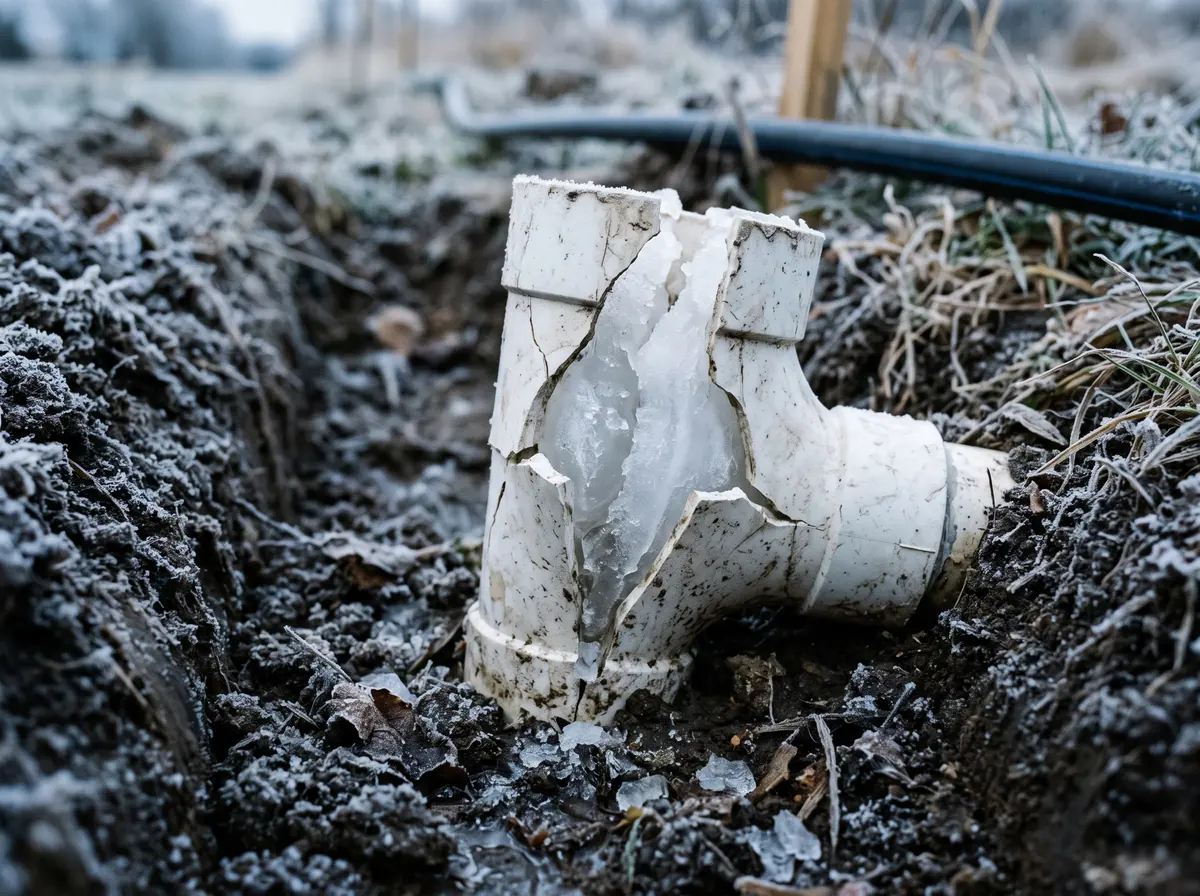
For context on the other side of the ledger: spring freeze-damage repairs commonly start around $200 for a single cracked fitting or head manifold and climb quickly from there. A freeze-split backflow assembly alone typically runs several hundred dollars to replace, and cracked lateral lines mean trenching. We wrote about what those repairs look like in our spring startup guide, most of the ugly surprises we find in April trace back to a skipped or botched October.
Why DIY blowouts crack pipes
Every fall someone asks whether the pancake compressor in the garage can do the job. Here’s the honest physics: winterization needs air volume (CFM), not air pressure (PSI), and home compressors have it backwards.
A long lateral run full of water needs a sustained, high-volume push to move that water out through the heads. A small tank can’t sustain the volume, so the water stalls halfway down the line. The natural response is to crank the pressure, and that’s where the damage happens. Excess pressure blows the seals out of heads, cracks fittings, and can damage the backflow assembly, all while still leaving water pooled in the low spots of the line.
Professional rigs are tow-behind compressors that deliver high volume at regulated, moderate pressure, enough to clear the line, never enough to hurt it. That’s the whole trick, and it’s why the service costs less than the parts it protects.
A note for fire-affected homes: this year it matters more
If your property was damaged in the August fires, winterization may be the last thing on your mind, and this year it belongs near the top of the list. A damaged system that still holds water will freeze like any other, and the expanding ice will crack the buried pipe and fittings that survived the fire, adding new damage after your insurance adjuster has already scoped the claim.
If your home is in the burn area, even if you can’t live there right now, have the system blown out or drained by mid-October. Our full guide to fire-damaged sprinkler systems covers the insurance side; we’re offering free itemized insurance estimates to affected families, and we can winterize what’s left of a system during the same visit.
FAQ
When should I winterize my sprinklers in Spokane? Between October 1 and October 15, before the first hard freeze. Book in late September for a slot in the safe window.
How much does a blowout cost? $75 to $150 for most residential systems as of 2026, based on zone count.
What if I skip it? Water freezes in the lines and cracks pipe, fittings, and the backflow assembly. You find out at spring startup, all at once.
Can I use my own compressor? We don’t recommend it, home compressors deliver too little volume and tempt you into too much pressure, which is exactly what cracks fittings and blows seals.
Does a fire-damaged system need winterizing? Yes. Freeze damage stacks on top of fire damage and complicates a claim that’s already been scoped. Get it drained by mid-October.
Get on the fall schedule
The October window fills every year. Call (509) 986-4262 or request your blowout online and we’ll get you on the calendar before the first freeze warning hits the forecast.
Revive Irrigation Services, Spokane, WA. (509) 986-4262. Serving Spokane, Spokane Valley, Liberty Lake, Mead, Cheney, and the greater Spokane area.
Frequently asked questions
When should I winterize my sprinklers in Spokane?
Schedule your blowout between October 1 and October 15. Spokane's first hard freeze typically arrives by mid-October, and a hard freeze with water still in the lines is what cracks pipe. Book in late September, the good slots go fast once the first frost warning hits the forecast.
How much does a sprinkler blowout cost in Spokane?
As of 2026, most residential systems run $75 to $150 depending on zone count. Larger systems and commercial properties cost more. Compare that to spring freeze-damage repairs, which commonly run several hundred dollars and up.
What happens if I don't winterize my sprinklers?
Water left in the lines freezes and expands with enough force to crack lateral pipe, split manifolds and fittings, and ruin the backflow assembly. You usually won't know until spring startup, when zones won't hold pressure and the repair bill arrives all at once.
Can I blow out my own sprinklers with a home air compressor?
We don't recommend it. Most home compressors have the wrong combination of pressure and air volume: too little volume to push water out of long lateral runs, so people compensate with too much pressure, which blows seals, cracks fittings, and can burst a head. Pros use high-volume, regulated air at moderate pressure, zone by zone.
Does a fire-damaged sprinkler system still need to be winterized?
Yes, arguably more than any other system in Spokane this year. If a system damaged in the August fires still holds water, a hard freeze will crack the pipe and fittings that survived, adding damage after your insurance adjuster has already scoped the claim. Have it blown out or drained by mid-October even if the home isn't currently livable.