
A sprinkler problem at a house is one homeowner’s headache. A sprinkler problem at a 40-unit townhome community is a board meeting, a water bill nobody wants to explain, and a wet sidewalk that somebody could slip on. Commercial irrigation in Spokane runs on the same parts as a backyard system, but the stakes and the scheduling are different.
This guide is for HOA boards, property managers, and owners of multi-family and commercial properties in the Spokane area. It covers how commercial systems differ from residential ones, what a yearly maintenance plan should include, who handles backflow testing, how to plan shut-offs across a big site, and what drives the cost.
Quick Answer
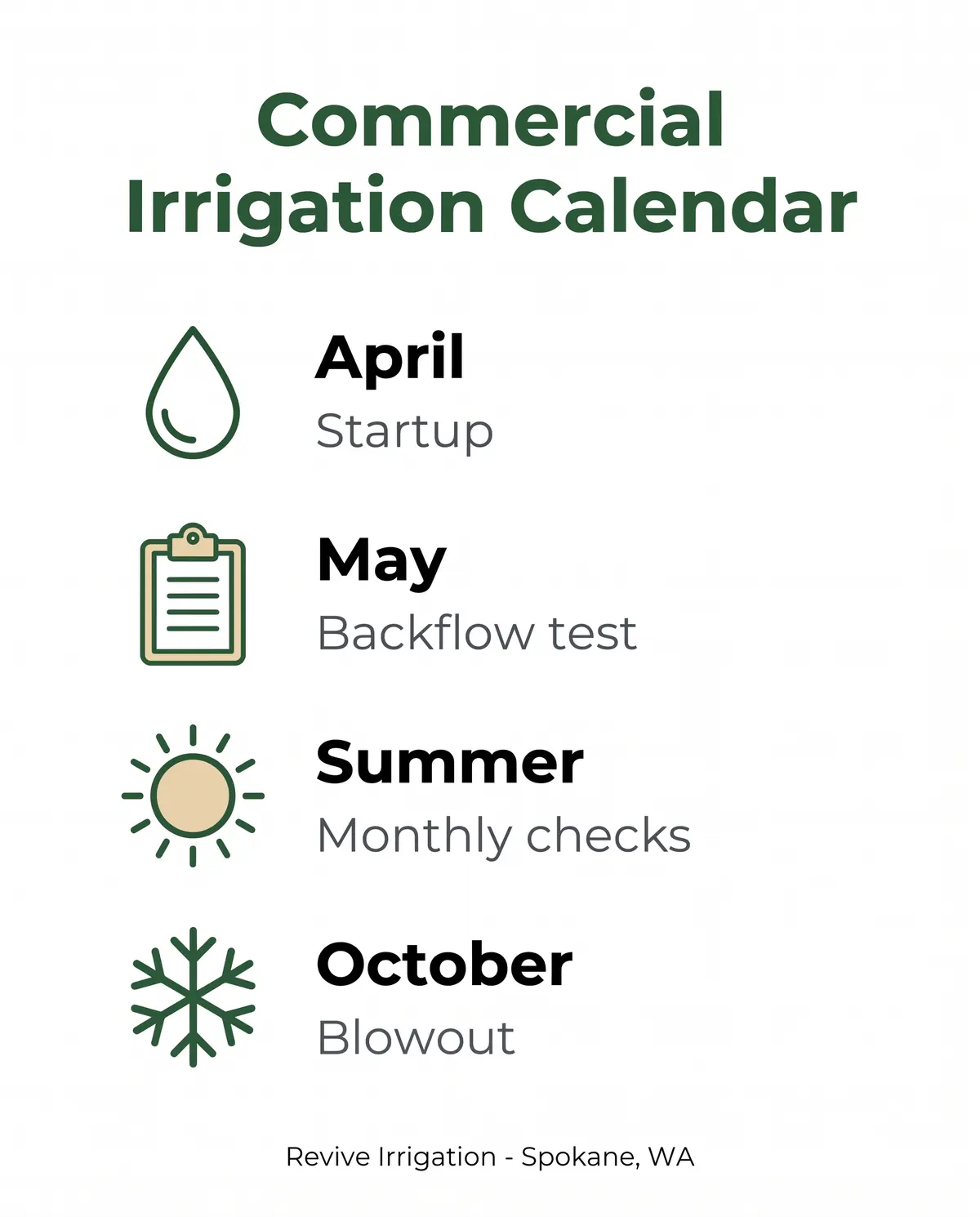
Commercial irrigation in Spokane needs four things on the calendar every year: a spring startup in April or May, an annual backflow test on every assembly, monthly checks through the summer, and a blowout before the first hard freeze in mid-October. Put one person in charge of that calendar and book the fall work in September. Commercial and HOA properties cost more than a single home because they have more zones, more controllers, and more backflow assemblies. Call Revive Irrigation at (509) 986-4262 to talk through your property.
How Is Commercial Irrigation Different From Residential?
The parts are familiar: a backflow assembly, valves, pipe, heads, and a controller. What changes is the scale and who is affected when something goes wrong.
- More of everything. A typical home has 4 to 10 zones on one controller. An HOA common area or apartment complex can have dozens of zones spread across several controllers, and more than one water service.
- Bigger pipe and bigger assemblies. Larger mainlines move more water, so a break wastes more of it faster. Backflow assemblies are larger, and some properties need a reduced pressure backflow assembly, which gives the highest level of protection.
- More people around it. Sprinklers run next to sidewalks, parking lots, entries, and mailboxes. Overspray is a nuisance at home. On a commercial property it is a hazard.
- More decision makers. A homeowner says yes on the spot. A board or an owner often needs a written estimate, a budget line, and a vote.
- Records matter. Managers change and boards turn over. A site map, a zone list, and a log of past repairs keep the next person from starting at zero.
The EPA’s WaterSense program notes that landscape irrigation is the primary source of outdoor water use for most commercial and institutional buildings. In Spokane’s hot, dry summers, with city water rates that tier up as use climbs, a system that runs a little wrong all season is expensive.
What Should an HOA Irrigation Maintenance Plan Include?
A good plan is short. It names four visits, who approves repairs, and who has the keys.
- Spring startup (mid-April to mid-May). Water goes back on slowly, every zone runs, and winter damage gets found and fixed before the heat arrives. Controllers get their summer programs.
- Annual backflow test. Every assembly on the property, tested and reported. The best time is right at startup.
- Summer checks (monthly, June through September). A walk-through with each zone running. The technician looks for broken or tilted heads, leaks, dry spots, and spray landing on pavement, and adjusts run times as the weather changes.
- Fall blowout (first half of October). Compressed air clears every zone so nothing is left to freeze. See our sprinkler blowout and winterization service for what that visit covers.
Beyond the dates, a plan should answer three questions before the season starts:
- Who approves repairs, and up to what amount? A technician who finds a broken head on a Tuesday should not have to wait for the next board meeting to fix it. Many boards set a dollar limit for on-the-spot repairs and ask for a written estimate above it.
- Who has access? Controller rooms, locked valve boxes, the irrigation shutoff, and any gate codes.
- Where is everything? A simple map of water shutoffs, backflow assemblies, controllers, and valve boxes saves time on every visit.
November through February is the right time to set this up. The system is off, the budget for next year is being written, and nobody is in a hurry.
Who Is Responsible for Backflow Testing on a Commercial Property?
The water customer is. For an HOA, that is usually the association for common-area systems. For an apartment or commercial site, it is the owner, with the property manager handling the scheduling.
A backflow assembly is the valve assembly that keeps irrigation water from flowing backward into the drinking water. The City of Spokane’s cross-connection control program says state regulations require all customers, residential, multifamily and commercial, to test their backflow devices every year. The test must be done by a Washington State-certified Backflow Assembly Tester, and the city recommends testing before the irrigation system is turned on. An assembly that gets repaired has to be retested. The city can shut off water service to a property that does not comply.
Two things trip up larger properties:
- More than one assembly. A site that was built in phases or expanded over the years often has several. Each one needs its own test and its own report.
- Lost paperwork. When a management company changes, test records often do not make the move. If you are not sure when your assemblies were last tested, your water purveyor can tell you what is on file.
The simplest fix is one annual date for every assembly on the property, tied to spring startup. Our backflow testing page explains the test and what happens when an assembly fails.
How Do You Schedule Shut-Offs and Blowouts Across a Large Property?
Timing is where commercial properties get into trouble. The first hard freeze in Spokane usually arrives by mid-October, and it does not wait for a board vote.
Book early. A single home takes one short visit. A large property can take most of a day, or more than one. Get on the schedule in September so the work lands in the first half of October.
Give residents notice. Tell people which day the crew will be on site, that the irrigation will be off for the season afterward, and to keep cars and patio furniture clear of valve boxes and backflow assemblies.
Know your shutoffs. Someone on site should know where the irrigation shutoff for each building or area is, and how to close it. When a mainline breaks at 6 PM on a Friday, that knowledge is the difference between a wet lawn and a flooded parking lot.
Run water when people are not around. In summer, schedule zones near walkways and entries for the early morning hours. In the shoulder seasons, watch the forecast. Water that lands on a sidewalk on a cold October morning can turn to ice.
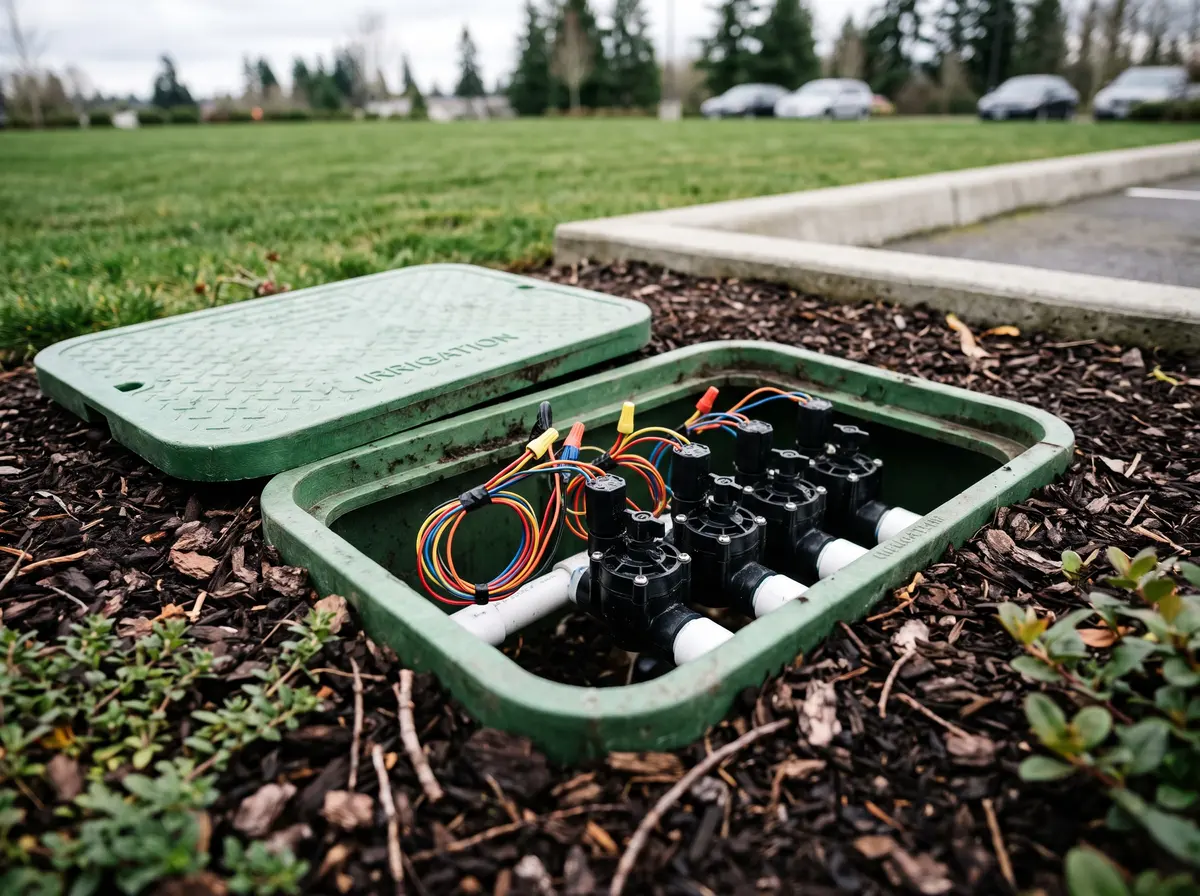
The liability side is simple to state. Spray on sidewalks and parking lots, heads sticking up beside a path, and soggy ground near an entry are all things a visitor can slip or trip on. Regular checks, and a record that the checks happened, are the practical answer.
How Much Does Commercial Sprinkler Service Cost in Spokane?
There is no single commercial price, because no two properties are alike. Here is what moves the number:
- Zone count. The biggest factor for startups and blowouts.
- Controllers and backflow assemblies. Each one adds time. Backflow tests are priced per assembly.
- The age and condition of the system. Older systems with mixed parts and no map take longer to diagnose.
- Access. Locked rooms, buried valve boxes, and valves under landscaping all slow the work.
- Drip zones. Beds and planters on drip take extra care at blowout time.
For scale, as of 2026 our residential ranges in Spokane are $75 to $150 for a blowout, $85 to $175 for a spring startup, $60 to $120 per assembly for a backflow test, and $75 to $400 for most repairs. Commercial and HOA properties cost more. The full list is on our Spokane sprinkler prices page.
For a commercial property, we walk the site, count the zones and assemblies, and give you a good estimate. The final cost depends on what the job turns up, especially on an older system. If the board needs something in writing for the budget, tell us when you call.
Get Your Property on the Schedule
Brad and Joe have spent more than 20 years each on Spokane sprinkler systems, including the older, complicated ones that have been added onto for decades. If you manage an HOA, an apartment community, or a commercial property and want next season lined up before spring, call (509) 986-4262 or get on the schedule online. Our office is open Monday to Friday, 8 AM to 4:30 PM.
Revive Irrigation Services, Spokane, WA. 2303 W Rosewood Ave, Spokane, WA 99208. (509) 986-4262. Serving Spokane, Spokane Valley, Liberty Lake, Mead, Cheney, Deer Park, Airway Heights, Five Mile Prairie, Nine Mile Falls, and Elk.
Frequently asked questions
Who is responsible for sprinkler maintenance in an HOA?
It depends on the governing documents. In most communities the association maintains the irrigation in common areas, and each owner maintains the system on their own lot. Some townhome and condo associations cover every lawn. Check your CC&Rs, then make sure one person on the board or at the management company owns the irrigation calendar.
Do commercial properties in Spokane need a backflow test every year?
Yes. The City of Spokane says state regulations require all customers, residential, multifamily and commercial, to test their backflow assemblies every year, and the test has to be done by a Washington State-certified Backflow Assembly Tester. A property with several assemblies needs each one tested.
How much does commercial sprinkler service cost in Spokane?
It depends on zone count, the number of controllers and backflow assemblies, and the condition of the system. For scale, as of 2026 a residential blowout in Spokane runs $75 to $150 and a spring startup $85 to $175. Commercial and HOA properties cost more. We walk the property and give you a good estimate, and the final cost depends on what the job turns up.
When should a commercial property schedule its sprinkler blowout in Spokane?
Get on the schedule in September and have the work done in the first half of October. The first hard freeze in Spokane usually arrives by mid-October, and a property with many zones and buildings takes longer to clear than a single yard.
How often should a commercial irrigation system be checked in summer?
Once a month during the watering season is a sensible baseline. A monthly walk-through with every zone running catches broken heads, leaks, and overspray onto sidewalks and parking lots before they turn into a high water bill or a complaint.
Does Revive Irrigation work on commercial and HOA properties?
Yes. Revive Irrigation services sprinkler systems for HOAs, property managers and commercial properties around Spokane, along with homes. Call (509) 986-4262 to talk through your property.