
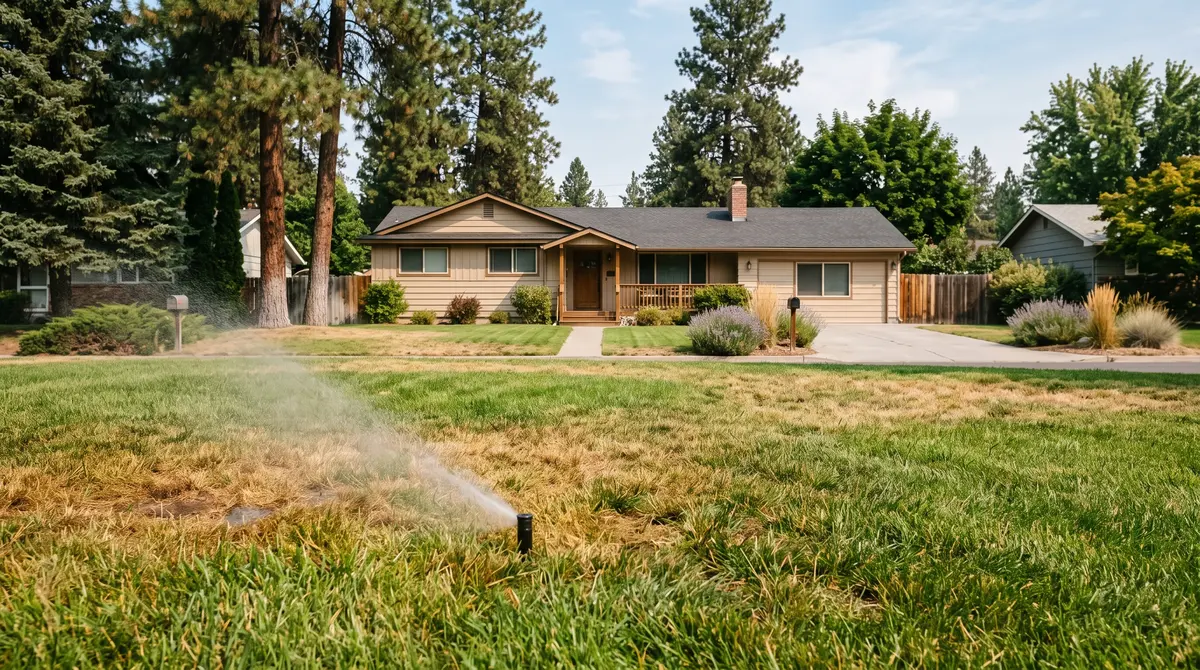
Every August, we get the same call from homeowners across Spokane: “My lawn was green in June, and now it’s got brown spots everywhere. Is it dead?” Usually, no. And it’s usually not grubs or fungus either. In our experience working on sprinkler systems around Spokane for over 20 years, the most common cause of brown spots is water that never reaches the grass. This post shows you how to tell the difference between a coverage problem and everything else, and how to test it yourself in 15 minutes.
Quick Answer: Brown spots in a Spokane lawn during summer are most often caused by uneven sprinkler coverage, not disease or pests. Clogged nozzles, tilted or sunken heads, poor head spacing, and low water pressure leave predictable dry zones that turn brown in July heat. A 15-minute catch-can test will confirm it: if some areas of a zone catch half as much water as others, your sprinklers are the problem.
Why Does My Lawn Have Brown Spots?
Grass turns brown for one big reason: the crown of the plant isn’t getting what it needs. In Spokane’s semi-arid summers, with stretches above 90 degrees in July and August, the “what it needs” is almost always water. Lawns here need roughly 1.0 to 1.5 inches per week at peak summer, and a sprinkler system that delivers that unevenly will paint the shortfall right onto your lawn.
There are other causes, and they matter because the fixes are completely different:
- Uneven sprinkler coverage. The most common culprit. Dry zones form between heads, along curb strips, on slopes, and anywhere pressure drops.
- Fungal disease. Necrotic ring spot and similar diseases show up as circular patches, sometimes with green centers.
- Grubs and pests. Billbug and grub damage peaks in late summer. The tell: damaged turf pulls up like loose carpet because the roots are eaten.
- Dog urine. Small, concentrated circles with a dark green halo.
- Heat and soil. South-facing slopes and the rocky, fast-draining pockets common on the South Hill and Five Mile dry out faster than the rest of the yard.
Before you spend money on fungicide or reseeding, rule out the sprinklers first. It’s the cheapest thing to check and the most likely answer.
How Can I Tell If It’s My Sprinklers and Not Disease?
Read the pattern, then test it. Sprinkler-caused brown spots follow the geometry of your system: they show up in the same places every year, they have irregular edges, and they sit in the gaps: between heads, at the far corners of a zone, or behind shrubs that block spray. Grass in a dry spot is firmly rooted and will green back up when it gets water. Disease patches tend to be circular, can spread week to week, and the grass may lift easily with discolored, rotted roots. Washington State University Extension has a good rundown of turf diseases if you want to compare symptoms; see the WSU Extension lawn care resources for the science.
The definitive check is the catch-can test:
- Set out 6 to 8 straight-sided cans (tuna cans work well) spread evenly across the zone with the brown spots, including one or two right in the brown areas.
- Run that zone for 15 minutes.
- Measure the water depth in each can with a ruler.
- Compare. If the cans in the brown areas caught half (or less) of what the wettest cans did, you’ve found your problem. It’s coverage, not disease.
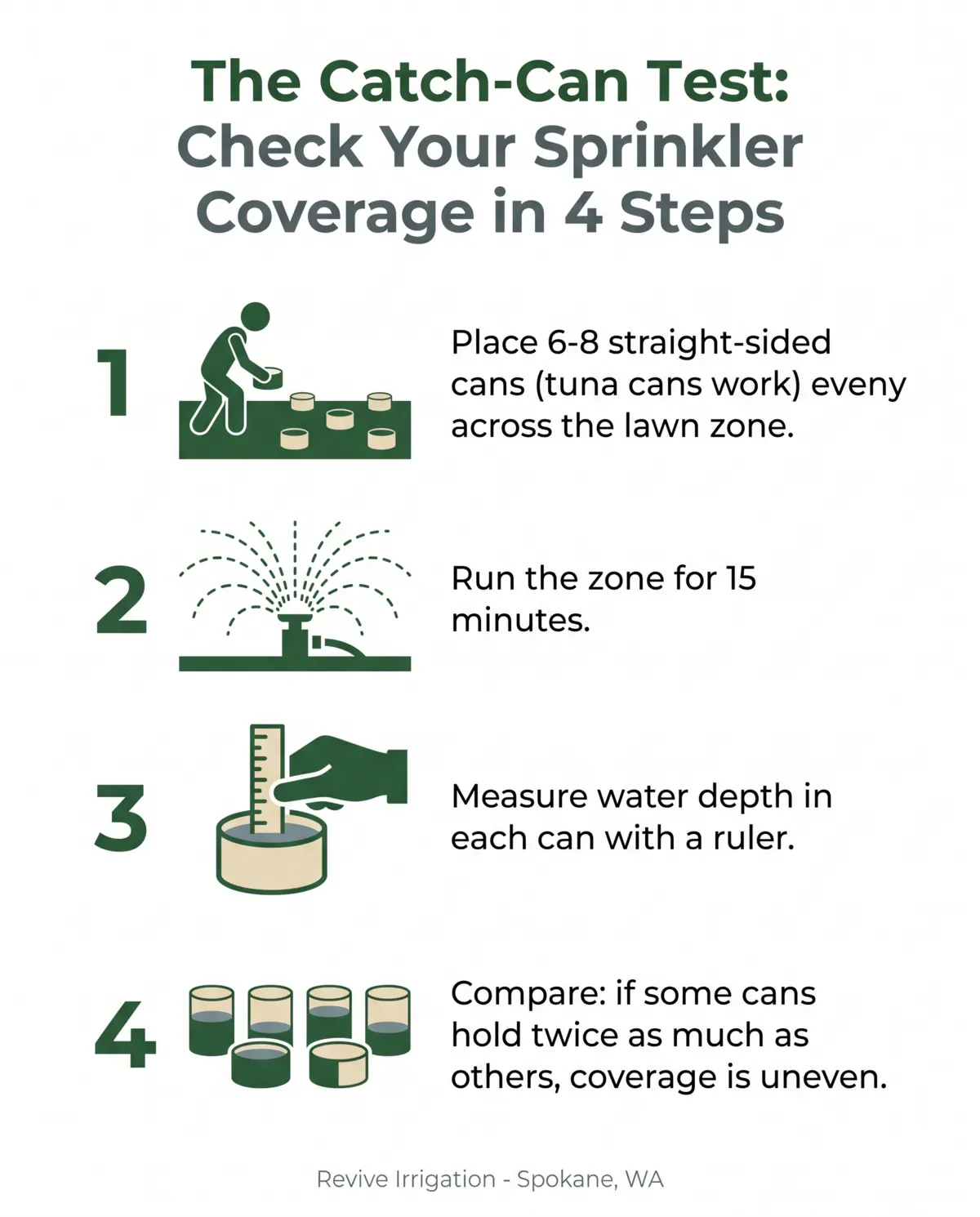
This is the same principle behind a professional irrigation audit. We just use more cans and a pressure gauge.
What Sprinkler Problems Cause Brown Spots?
Once the catch-can test points at coverage, one of these is almost always behind it:
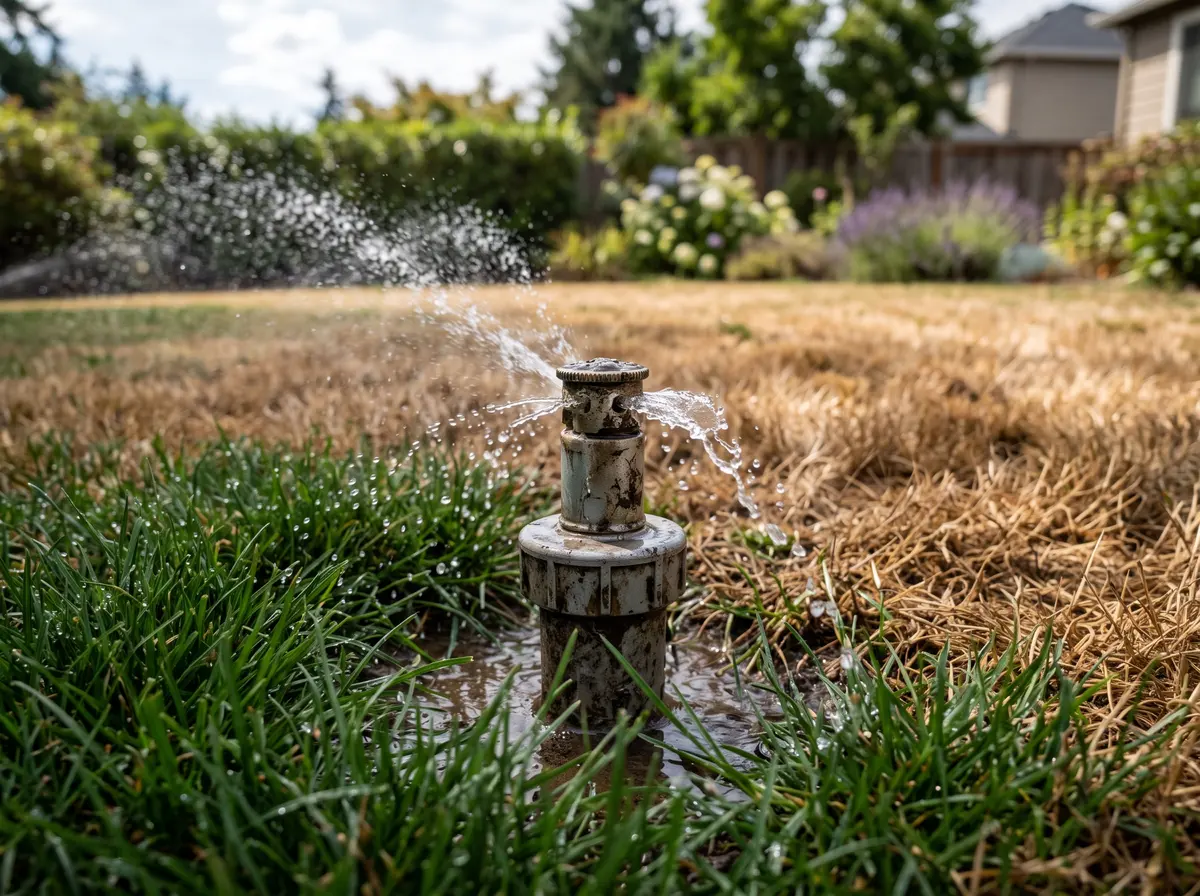
Clogged or worn nozzles. Spokane’s water carries fine grit that plugs spray nozzles over time. A partially clogged nozzle mists instead of throwing a full pattern, so the far edge of its arc goes dry.
Tilted or sunken heads. Mower strikes, foot traffic, and settling soil knock heads off vertical. A head leaning even 10 degrees throws its pattern short on one side. Sunken heads spray into the grass right around them and nothing else.
Head spacing and blocked spray. Sprinkler patterns are designed for head-to-head coverage, meaning each head’s spray should reach the next head. Systems installed short on heads, or landscapes that grew up around them (a shrub that was knee-high in 2015 is a spray wall today), leave permanent gaps.
Low or mismatched pressure. Too many heads on one zone, a partially closed valve, or a leak underground drops pressure so the last heads on the line barely pop up. Mixing rotors and spray heads on the same zone causes the same symptom, because they apply water at very different rates.
Runtime and scheduling. Sometimes coverage is fine but the schedule isn’t. Ten minutes a day evaporates before it soaks in. Spokane lawns do better with 2 to 3 deep waterings per week, early in the morning, following the cycle-and-soak approach the EPA WaterSense program recommends. With the City of Spokane’s tiered summer water rates, fixing coverage usually costs less than the water wasted compensating for it.
Can I Fix Uneven Sprinkler Coverage Myself?
Some of it, yes. Cleaning a clogged nozzle is a 5-minute job: unscrew the nozzle, rinse the filter screen, reinstall. Straightening a slightly tilted head can often be done by hand-packing soil around it. Swapping a worn nozzle for a matching replacement is homeowner territory too, as long as you match the brand, arc, and throw radius.
Where DIY usually goes sideways is anything involving spacing, pressure, or pipe. Adding a head to close a coverage gap means teeing into the lateral line and confirming that zone can handle the extra flow. Diagnosing a pressure drop means figuring out whether it’s a leak, a valve problem, or a design problem. Get it wrong and you turn one brown spot into a whole struggling zone. That’s the point where a diagnostic visit pays for itself, especially on older Spokane systems where the original layout was marginal to begin with.
When Should You Call a Pro in Spokane?
Call us when the brown spots come back every summer in the same places, when a whole zone looks weak, when heads won’t pop up fully, or when your water bill climbs and the lawn still looks thirsty. Those are system problems, not maintenance chores.
Brad and Joe have spent a combined 60+ years diagnosing Spokane sprinkler systems, including the older and quirky ones other techs walk away from. We’ll audit your coverage, test your pressure, and give you a straight answer about whether you need a $60 nozzle fix or a zone redesign. Most coverage repairs are same-week, and estimates on bigger work are free.
Take a look at our full sprinkler repair and irrigation services, or contact us online to get on the schedule. You can also just call: (509) 986-4262. August is prime time to fix coverage problems, because whatever’s brown now still has time to recover before fall.
Revive Irrigation Services, Spokane, WA. Serving Spokane, Spokane Valley, Liberty Lake, Mead, Cheney, and the greater Spokane region from 2303 W Rosewood Ave, Spokane, WA 99208. Monday–Friday, 8:00 AM – 5:00 PM. (509) 986-4262.
Frequently asked questions
Why does my lawn have brown spots even though I water every day?
Daily watering doesn't help if the water never reaches the spot. Uneven sprinkler coverage from clogged, tilted, or poorly spaced heads is the most common cause of brown spots in Spokane lawns. A catch-can test will show whether the brown areas are actually getting water.
How do I tell if brown spots are from my sprinklers or lawn disease?
Check the shape and the roots. Sprinkler-caused spots have irregular edges, sit in predictable zones (between heads, along edges, on slopes), and the grass pulls up firm. Disease patches are often circular with smoky or discolored rings, and grass in fungal patches may pull up easily with rotted roots.
What is a catch-can test?
Set 6 to 8 straight-sided cans across one sprinkler zone, run the zone for 15 minutes, then measure the water depth in each can. If some cans catch twice as much water as others, your coverage is uneven and the driest cans mark your brown spots.
How much water does a Spokane lawn need in summer?
About 1.0 to 1.5 inches per week in July and August, applied in 2 to 3 deep waterings rather than a light daily sprinkle. Early morning is the best time to water.
Can dog urine cause brown spots in a lawn?
Yes. Dog spots are small, concentrated circles, often with a ring of darker green around the edge, usually near walkways or favorite corners. They show up regardless of how well your sprinklers cover the area.
How much does it cost to fix uneven sprinkler coverage in Spokane?
Simple fixes like nozzle cleaning or head replacement typically run $50 to $150 as of 2026. Re-spacing heads or correcting a pressure problem costs more depending on the zone. Request a free estimate for anything beyond a single head.