Your Spokane lawn hits its hardest stretch in July and August. Daytime highs push past 90, the air is dry, and City of Spokane water rates climb into their summer tier. Water too little and the lawn browns out. Water too much and you throw money down the storm drain and invite disease. The good news: there is a simple schedule that keeps grass green through the worst of a Spokane summer without wasting a drop. Here is exactly how long, how often, and when to run your system.
Quick Answer
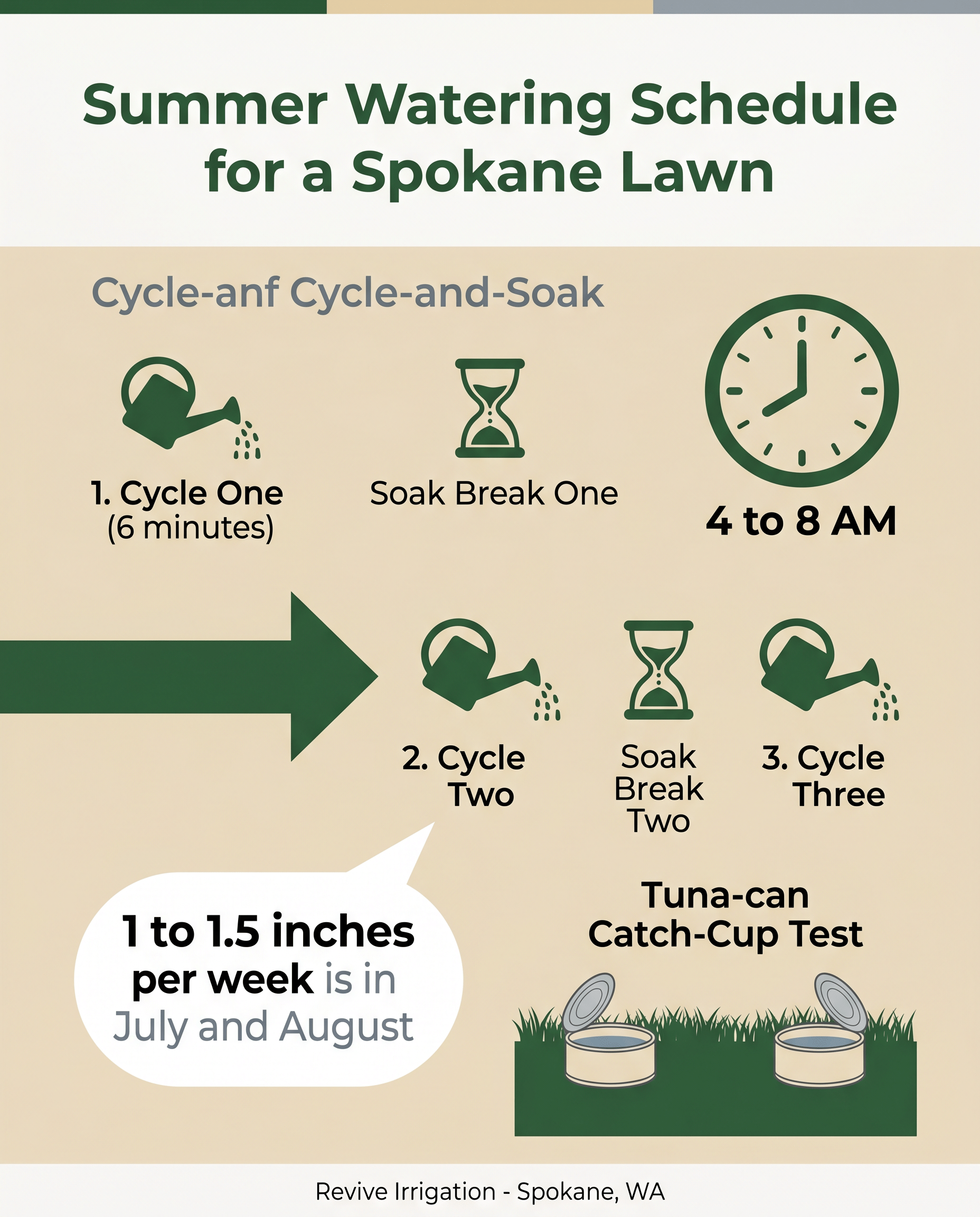
A Spokane lawn needs about 1 to 1.5 inches of water per week in July and August, delivered in two or three deeper sessions rather than a little every day. Water in the early morning, roughly 4 to 8 AM, and use cycle-and-soak (splitting each zone into two or three short bursts) so water soaks in instead of running off. Deep, infrequent watering builds stronger roots and a tougher lawn.
How much water does a Spokane lawn need in summer?
The target most turf specialists agree on is roughly one inch of water per week for cool-season grass, rising toward 1.5 inches during the hottest, driest weeks. Spokane summers sit right in that upper range. With 90-degree days common in July and August and very little rain, your lawn leans almost entirely on the irrigation system to hit that number.
That inch includes any rainfall, which in a Spokane summer is usually close to zero. So plan to supply the full amount yourself. The University of Washington State University Extension turf guidance backs up this deep-and-infrequent approach for the Inland Northwest, and you can read more through WSU Extension.
Splitting the weekly total across two or three days matters more than most people expect. Watering a third of an inch every single day keeps the top of the soil damp and the roots shallow. Delivering half an inch three times a week pushes moisture deeper, and roots follow it down. Deeper roots mean a lawn that shrugs off a hot week instead of wilting the moment you skip a session.
What is the best time to water grass in Spokane?
Early morning wins, and it is not close. Aim to have your system finish before 8 AM. Between about 4 and 8 AM the air is cool and usually still, so far less water evaporates before it reaches the roots, and less drifts off target on a breeze. The lawn then has all day to dry at the surface.
Midday watering wastes water to evaporation under the Spokane sun. Evening and overnight watering does the opposite problem: the grass stays wet for hours in the dark, which is exactly the condition lawn diseases like to grow in. Morning threads the needle. If your controller lets you set a start time, put your longest zones first so everything wraps up before the day heats up.
If you are away or forget to adjust seasonally, this is one of the clearest cases for a smart controller. It pulls local weather and skips or trims cycles automatically. The EPA’s WaterSense program certifies controllers that measurably cut outdoor water use, and several qualify for utility rebates.
How do I set a cycle-and-soak schedule?
Cycle-and-soak is the single biggest upgrade most Spokane homeowners can make to a summer schedule. Instead of running a zone for one long stretch, you split it into two or three shorter bursts with a rest in between so the water can absorb.
Here is why it matters locally. Much of the Spokane metro sits on glacial silt loam, and the South Hill and Five Mile areas have rocky and clay pockets. Clay and compacted soil can only take in water so fast. Run a zone for 30 straight minutes and the last 10 often sheets off across the driveway and down the gutter. That is water you paid for, doing nothing.
To set it up, take the total run time a zone needs and divide it into two or three cycles. If a spray zone needs 30 minutes, program three 10-minute runs with about an hour between them. Most modern controllers support multiple start times or a built-in soak feature that does this for you. On slopes and clay-heavy yards, the difference in absorption is easy to see: no runoff, and green all the way to the edges.
A simple starting point by head type
Spray heads put out a lot of water fast, so they usually need 20 to 40 total minutes per zone per session, split into cycles. Rotor heads apply water more slowly and evenly, so they often need 40 minutes to an hour per zone, also split. These are starting points, not final numbers. Your pressure, head spacing, and soil all shift the math, which is why the catch-cup test below is worth ten minutes of your time.
How do I know if I am watering the right amount?
Guessing leads to brown spots or wasted water. Measuring takes the guesswork out. The catch-cup test is the field-proven way to learn what your system actually delivers.
Set out five or six identical straight-sided containers around one zone. Empty tuna cans or cat-food cans are perfect because they are about an inch tall. Space them across the coverage area, run the zone for 15 minutes, then measure the water depth in each can with a ruler. Average the depths, then do the math to find how long it takes to reach your target. If you caught a quarter inch in 15 minutes, you know that zone needs about 60 minutes total to put down one inch, which you would then split into cycles.
The cans also expose coverage problems. If one can is nearly full and another is nearly empty, you have uneven coverage from a tilted head, a clogged nozzle, wrong head spacing, or low pressure. No schedule fixes a coverage problem. That is a repair issue, and it is one of the most common things we get called out for. You can see our full range of irrigation and sprinkler services if a zone is watering unevenly no matter how you program it.
How should I adjust the schedule through the season?
A summer watering schedule is not set once and forgotten. Spokane’s weather swings, and your controller should follow it.
In early summer, before the real heat, most lawns do fine on the lower end, closer to one inch a week across two days. As July and August bring sustained 90-degree stretches, bump toward 1.5 inches and add a third day if the lawn starts to dull. During a genuine heat wave, resist the urge to switch to short daily watering. Keep the deep sessions, and if you see midday heat stress, a single brief syringe cycle (a few minutes to cool the crown) helps more than shallow daily runs.
When the weather cools in September, dial back. Lawns need far less water as days shorten and temperatures drop, and many systems keep running summer amounts long after the grass needs them. Cutting back in fall saves money and sets you up for winterization season. Signs you are overwatering include spongy soil, mushrooms, and runoff. Signs of underwatering include a bluish-gray cast, footprints that stay pressed in the grass, and browning that starts on the edges and slopes first.
Common Spokane summer watering mistakes
The most frequent one we see is daily short watering, which grows a shallow-rooted lawn that cannot handle a hot week. Close behind is watering in the heat of the day, watering at night, and never adjusting the controller from spring through fall. Mismatched heads on a single zone, mixing spray and rotor, also guarantee some spots get too much and others too little, because the two head types apply water at very different rates.
Most of these are fixable in an afternoon, either by reprogramming the controller or correcting a few heads. If you would rather have it dialed in for you, or a zone keeps browning no matter what you try, that is what we do.
Water smart this summer with Revive Irrigation
A well-tuned system is the cheapest upgrade you can make to both your lawn and your summer water bill. We are Spokane locals with more than 60 combined years working on systems all over this region, from Five Mile clay to Spokane Valley silt loam. We will audit your coverage, set a season-smart schedule, fix uneven zones, and can install a WaterSense smart controller that manages the timing for you.
Call Revive Irrigation at (509) 986-4262 for a free estimate, or reach us through our contact page. We serve Spokane, Spokane Valley, Liberty Lake, Mead, Cheney, and the greater Spokane area.
Revive Irrigation Services — Spokane, WA. (509) 986-4262.
Frequently Asked Questions
How long should I water my lawn in Spokane in the summer?
Aim for about 1 to 1.5 inches of water per week in July and August, split across two or three days. For most in-ground systems that is roughly 20 to 40 minutes per zone per session for spray heads, and longer for rotors. Run a catch-cup test to dial in your exact times.
What is the best time to water grass in Spokane?
Water in the early morning, between about 4 and 8 AM. It is cooler and calmer, so less water evaporates or blows off target, and the grass dries by midday, which lowers disease risk. Avoid evening watering that leaves the lawn wet overnight.
How often should I water my lawn in Spokane summers?
Two to three deeper sessions per week beat daily light watering. Deep, infrequent watering trains roots to grow down, which makes the lawn more drought-tough during Spokane’s hot, dry July and August.
What is cycle-and-soak watering?
Cycle-and-soak splits each zone’s run time into two or three shorter bursts with a soak break between them. On Spokane’s silt loam and clay pockets, this lets water absorb instead of running off down driveways and sidewalks.
Should I water my lawn every day in a Spokane heat wave?
Usually no. Even during a 95 degree stretch, deep watering two or three times a week is better for the lawn than daily sprinkling. If you see heat stress, add one short midday syringe cycle rather than switching to shallow daily runs.
Revive Irrigation Services — Spokane, WA. Call (509) 986-4262 or request a free estimate. Serving Spokane, Spokane Valley, Liberty Lake, Mead, Cheney, and the greater Spokane area.