If you live in Spokane, the first warm weekend of spring brings the same itch: get the sprinklers running so the lawn doesn’t fall behind. We get it. But every year we drive out to homes where someone flipped the system on too fast, too early, or skipped a step — and what could have been a free DIY startup turned into a $400 repair.
This guide walks you through a safe spring sprinkler startup in Spokane, what can go wrong, and when it’s worth calling Revive Irrigation instead of fighting it yourself.
Quick Answer
In Spokane, schedule your spring sprinkler startup between April 15 and May 15, after the last hard freeze. Open the main shut-off valve slowly — over 30 to 60 seconds — then walk each zone to check for leaks, broken heads, and coverage gaps before you trust the system to run automatically. If you see water where it shouldn’t be, shut the system down and call a professional.
When Should You Turn On Sprinklers in Spokane?
Spokane sits in USDA Hardiness Zone 6a/6b, which means our last hard freeze usually falls in mid-May, with cold snaps possible into early May in colder pockets like the South Hill, Mead, and Deer Park.
A safe rule: wait until overnight lows have stayed above 32°F for at least a week, and the 10-day forecast doesn’t show another freeze. Most years that lands somewhere between April 15 and May 15.
Turning sprinklers on too early is the single most common cause of broken heads and cracked PVC we see in May. Cold-soaked pipes don’t flex; they crack.
What You Need Before You Start
Before you touch the main valve, make sure you have:
- A flat-blade screwdriver (for manual valve operation)
- A pair of slip-joint pliers
- A flashlight (for the valve box and any meter pit)
- A working irrigation controller (replace the backup battery if it’s been a year)
- A clear walking path to every sprinkler head — move patio furniture, planters, and yard debris
You don’t need to drain anything or do any prep beyond confirming no obvious damage to exposed components — your blowout last fall handled the rest.
Step-by-Step: Spring Sprinkler Startup
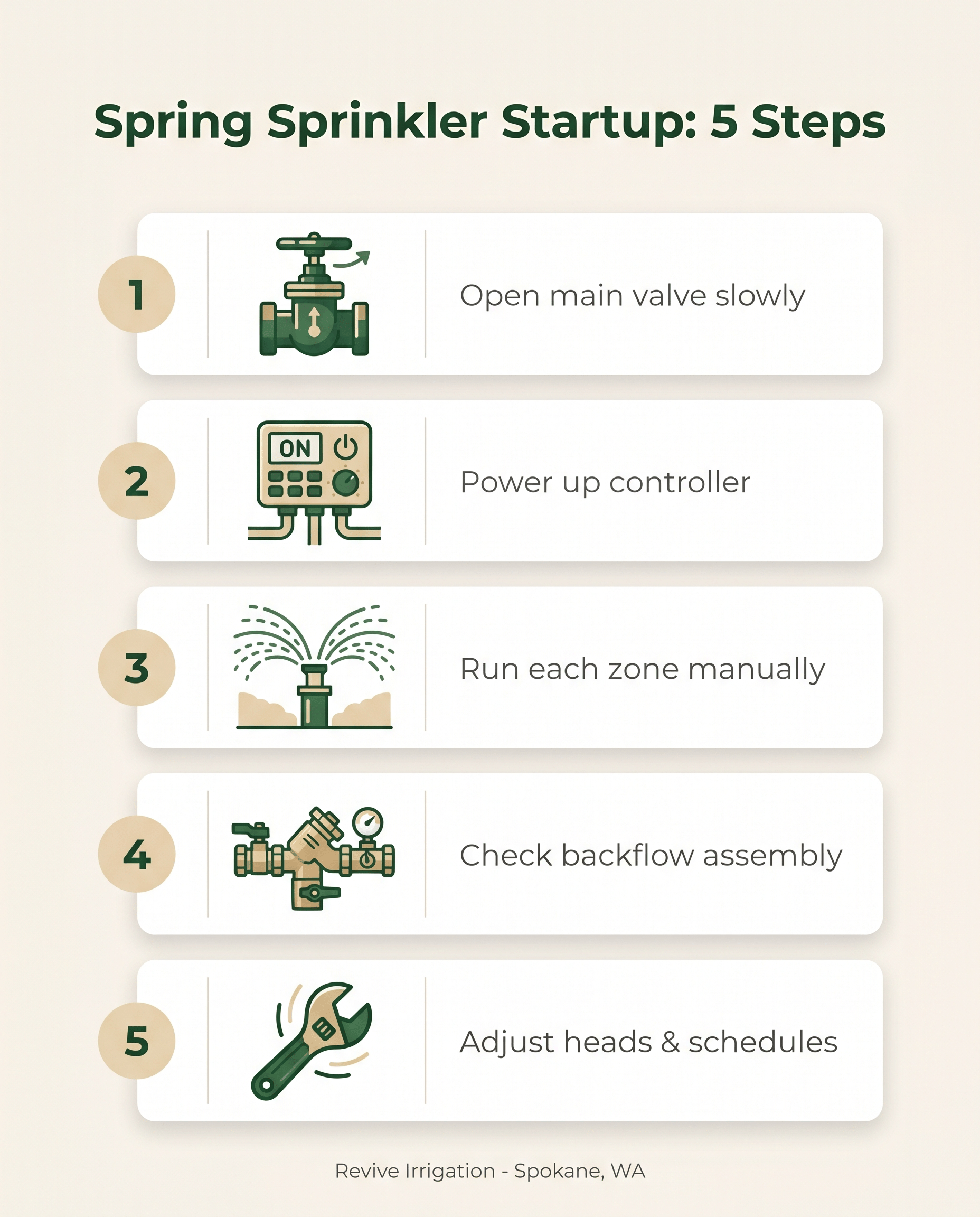
1. Locate and Open the Main Shut-Off Valve Slowly
Your main irrigation shut-off is usually in a basement, crawlspace, or utility area near where the sprinkler line tees off the house’s water supply. Some Spokane homes have it in a meter pit near the curb instead.
Open the valve a quarter-turn at a time, pausing 10–15 seconds between turns, until it’s fully open. The whole process should take 30 to 60 seconds. This avoids “water hammer” — a pressure surge that can split fittings on a system that’s been dry all winter.
2. Power Up and Check the Controller
Plug in or flip on your controller. Confirm the date and time (most controllers reset after a power outage), and replace the 9V backup battery if it’s been a year. Check that your watering schedule still makes sense — if you ran a smart controller last year, look at its seasonal adjustment settings before letting it auto-water.
3. Run Each Zone Manually for 2–3 Minutes
This is the most important step. Use the controller’s manual or “test” mode to run every zone individually, one at a time. While each zone is running, walk it. You’re looking for:
- Heads that don’t pop up at all
- Heads spraying sideways, geysering straight up, or dribbling
- Wet spots in the lawn that aren’t from a head (leaks underground)
- Heads spraying onto sidewalks, driveways, or the side of the house
- Zones that come on weakly or won’t run at all
Write down what you see by zone number. Don’t try to fix things while another zone is running.
4. Check the Backflow Assembly
Look at the backflow preventer where your irrigation line leaves the house. You want no water dripping from any of the test cocks or the bonnet. Even a slow drip means a worn rubber check inside the assembly, and it’ll only get worse.
In Washington State, your irrigation backflow assembly needs to be tested annually by a certified tester. If you haven’t had it done since last spring, schedule it now.
5. Adjust Heads and Reset Schedules
Spring is the right time to:
- Straighten heads that have shifted from frost heave
- Adjust spray patterns that are watering the driveway
- Replace nozzles on any heads with worn or broken parts
- Update the controller schedule for May watering (typically 2–3 days per week, 15–20 minutes per zone for spray heads, longer for rotors)
Common Spring Sprinkler Problems in Spokane
Even on a system that was properly winterized, spring startup can surface problems. The ones we see most often:
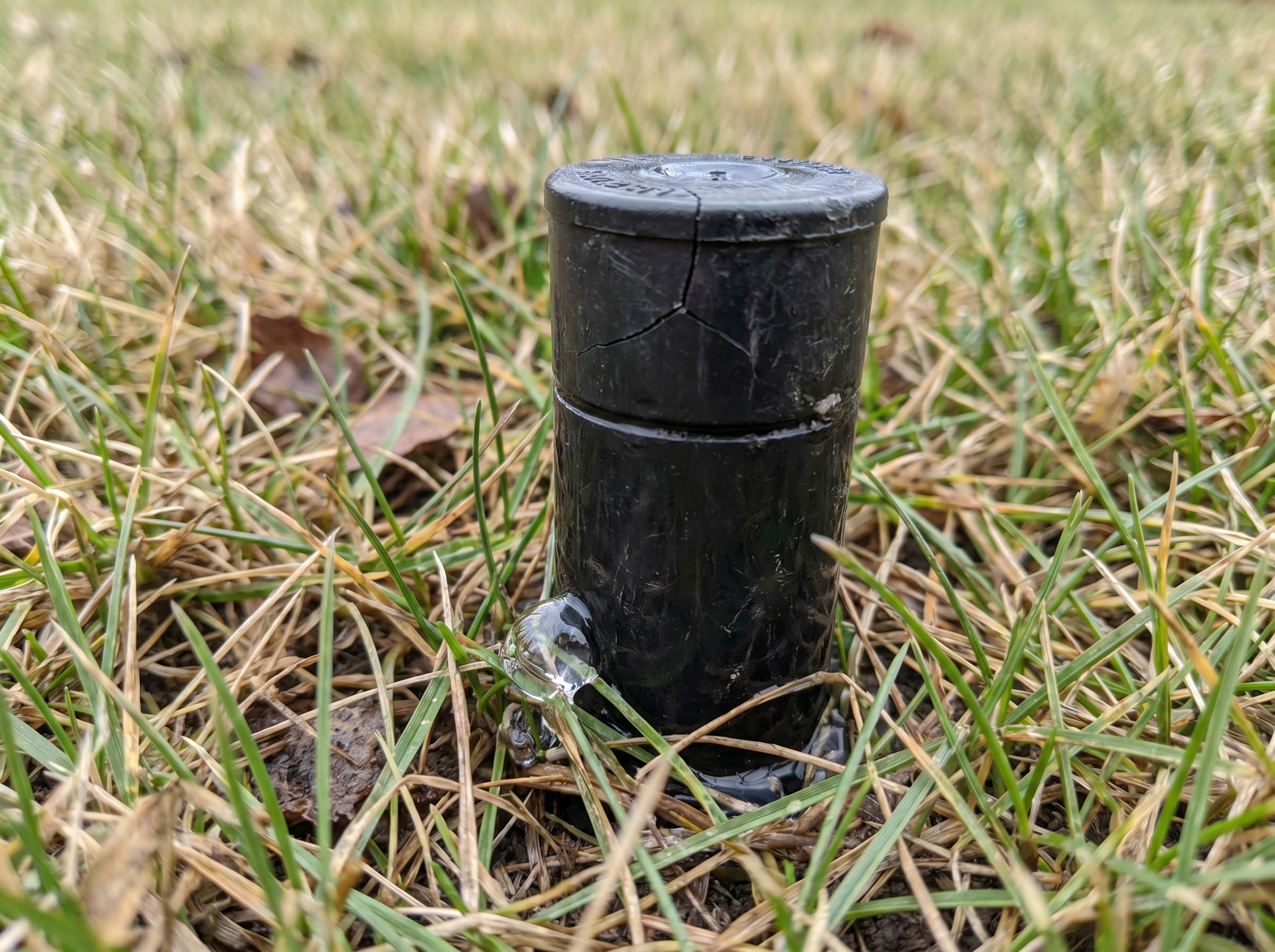
Cracked sprinkler heads. Even a small amount of water trapped in a head over winter can crack the body when it freezes. Symptom: water bubbling up around the head instead of spraying.
Broken or cracked PVC fittings. Usually at glued joints under heads or near the manifold. Symptom: a wet spot on the lawn that grows when a specific zone runs.
Failed solenoids. Electrical valves that won’t open (zone never turns on) or won’t close (zone runs constantly). Common after voltage spikes from winter storms.
Controller problems. Dead backup batteries, blown fuses on transformers, corroded wire splices in the valve box.
Cracked backflow assembly. The assembly itself is exposed to outdoor temperature swings, and a missed wrap or insulation can lead to a cracked brass body — a $250–$500 part plus labor.
If any of those show up during your walk-through, shut the system down at the main valve and call us before water damage spreads.
When to Call Revive Irrigation Instead
DIY startup makes sense for systems that were professionally winterized, are under 10 years old, and didn’t have known problems last fall.
Call us first if:
- Your system is older than 15 years and hasn’t been serviced recently
- You bought the home and don’t know the system’s history
- Multiple zones aren’t responding
- You see water surfacing in the lawn before any zone runs
- Your backflow assembly is dripping
- You want a tune-up that catches small problems before summer
A professional spring startup with Revive runs $85 to $175 for most residential systems, with any repairs quoted before we do them. We’ve started up several thousand Spokane systems between us — Brad and Joe have a combined 60+ years in this work, and a one-hour tune-up usually pays for itself in water bill savings and avoided summer breakdowns.
Book Your Spring Startup
Spring books up fast in Spokane — most years our calendar is full by the second week of May. Call (509) 986-4262 or request a free estimate and we’ll get you on the schedule.
We serve Spokane, Spokane Valley, Liberty Lake, Mead, Cheney, Deer Park, Airway Heights, and the surrounding communities. Locally owned, owner-operated, and on time.
Sources for water timing and freeze data: WSU Spokane County Extension, USDA Plant Hardiness Zone Map, and EPA WaterSense.
Frequently Asked Questions
When is the right time to start sprinklers in Spokane?
Most years, the safe window for spring startup in Spokane runs from April 15 to May 15, after the last hard freeze has passed. If snow is still on the ground or overnight lows are dipping below 28°F, wait.
Why won’t my sprinkler heads pop up after winter?
The most common causes in Spokane are a closed main shut-off valve, a tripped controller, low water pressure from a partially open valve, or a cracked head from winter freeze damage. Walk each zone manually before assuming the worst.
How much does a professional spring sprinkler startup cost in Spokane?
A standard residential startup typically runs $85 to $175 depending on system size, age, and how many heads or zones need adjustment. Repairs found during startup are billed separately.
Should I turn my sprinklers on slowly?
Yes. Open the main valve slowly — over 30 to 60 seconds — to avoid water hammer, which can crack pipes and damage valves that are still cold from winter.
Do I need a backflow test before turning on my sprinklers?
Washington State requires annual backflow testing on irrigation systems with cross-connections. Spring startup is a natural time to schedule the test, since the assembly is being pressurized again.
Revive Irrigation Services — Spokane, WA. Call (509) 986-4262 or request a free estimate. Serving Spokane, Spokane Valley, Liberty Lake, Mead, Cheney, and the greater Spokane area.